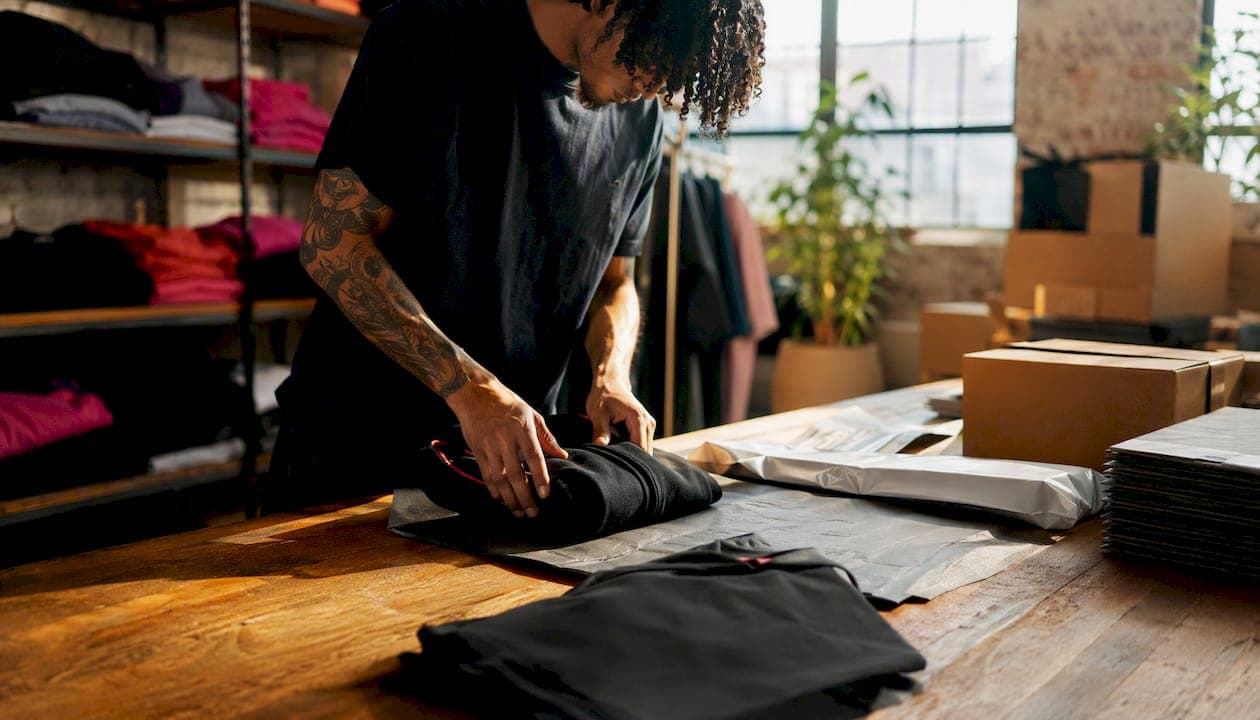
A merch drop is a limited-time, limited-quantity release of branded merchandise designed to create scarcity, build hype, and reward the most engaged fans. Creators, artists, and brands run them to turn a product release into an event. According to Kontentino's explainer, scarcity and urgency are what separate a drop from a regular sale — the window closes, the stock runs out, and that's the point.
Common merch drop formats include:
- Graphic tees, hoodies, and limited apparel
- Accessories like hats, lanyards, and phone cases
- Collectibles and blind-box figures
- Phygital items (physical merch bundled with digital music access)
- Signed posters, stickers, and fan packs
Key Takeaways
A merch drop is a limited-time, limited-quantity merchandise release that converts fan engagement into direct revenue through scarcity, urgency, and community exclusivity.
| Point | Details |
|---|---|
| Core definition | A merch drop is a timed, scarce release designed to create urgency — not an ongoing catalog item. |
| Plan 8–12 weeks out | Lock concept, source samples, and approve production before teaser content begins. |
| Scarcity must be real | Fake restocks after announced limits destroy community trust faster than any other mistake. |
| Tease early, layer reveals | Start teasing 2–3 weeks out; give email/SMS subscribers 48–72 hours of early access before going public. |
| Amaribandz approach | Amari Bandz runs limited apparel and phygital music card drops with email/SMS early access at amaribandz.com. |
Table of Contents
- How does a merch drop differ from a regular product launch?
- Why do brands and creators run merch drops?
- What does a merch drop actually include?
- How to plan and organize a merch drop
- How to tease and promote a merch drop
- Real-world examples and what they teach
- What can go wrong with a merch drop?
- Why I run drops instead of just selling merch
- Amaribandz drops: how to get early access
- Sources
How does a merch drop differ from a regular product launch?
The core difference is availability. A product launch opens a new item for ongoing sale — it goes into the catalog, gets restocked, and stays available. A merch drop, by contrast, does not promise continued availability. Once the window closes or the units sell out, that's it.
That distinction shapes everything about how you plan and promote each:
- Drop: limited units or a short sales window, announced in advance, often tied to a collab, season, or fan moment
- Product launch: ongoing availability, broader distribution, standard restocking cycle
- When to use a drop: capsule collabs, seasonal fan packs, artist-branded accessories, charity releases
- When to launch instead: core catalog items, everyday apparel, products you intend to restock regularly
Drop culture grew out of sneaker and streetwear releases in the 1980s and 1990s, where scarcity was baked into the model from day one. That origin explains why drops carry a status signal that a standard launch rarely does.
Why do brands and creators run merch drops?
The business case is stronger than it looks on the surface.
Marketing benefits are the obvious ones: drops generate buzz, create urgency, and give fans something to share. A countdown timer on Instagram Stories does more for conversion than a standard "shop now" post because the deadline is real.
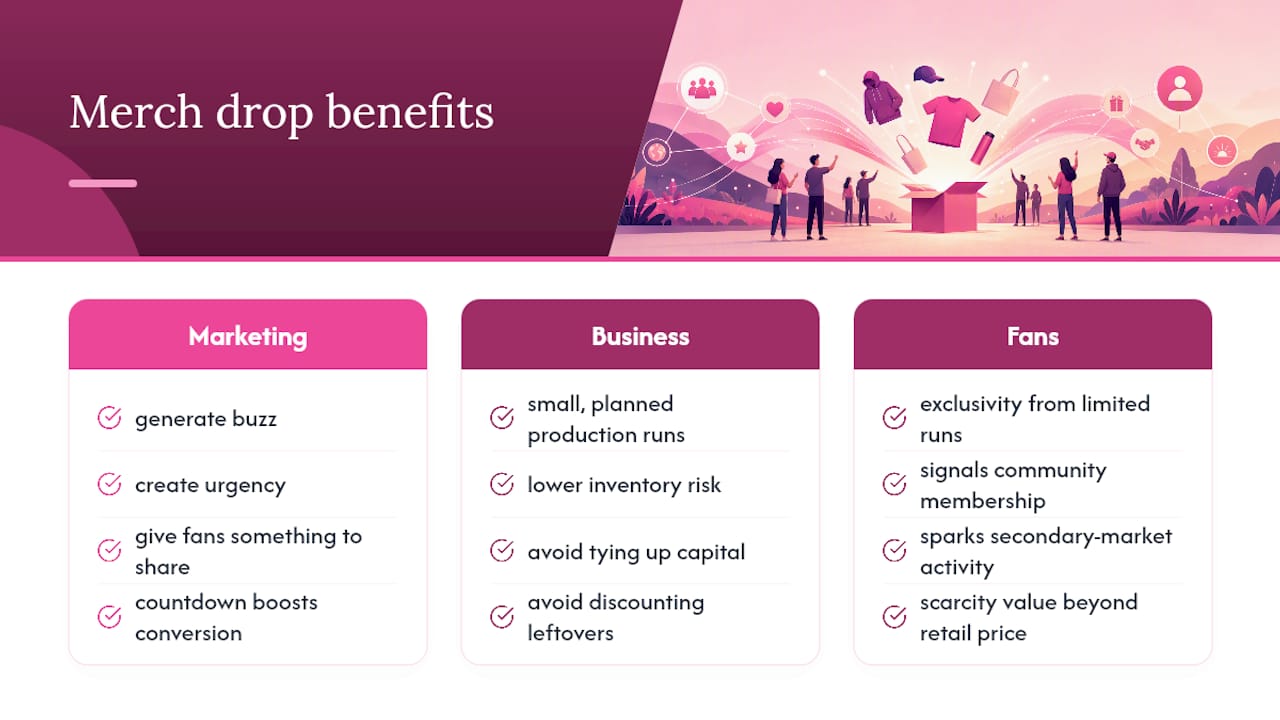
Business benefits are less obvious but arguably more valuable. Because production runs are small and planned in advance, drops lower inventory risk significantly. You're not tying up capital in slow-moving stock or discounting leftovers six months later. Queue-it's product drop guide notes that successful drops shift the relationship from transactional to experiential, which builds collector mentalities and reduces long-term waste.
Fan benefits center on exclusivity. Owning a piece from a limited run signals community membership in a way that mass-produced merch simply cannot. That's why drops often spur secondary-market activity — the item carries scarcity value beyond its retail price.
Pro Tip: Keep your stated scarcity honest. If you announce 100 units and then restock after sellout, the community notices. Authentic limits build trust; fake scarcity destroys it.
What does a merch drop actually include?
Product types vary widely, but the mechanics that make something a "drop" rather than a sale are consistent.
Common product types:
- Apparel: tees, hoodies, joggers, hats
- Accessories: tote bags, phone cases, keychains, jewelry
- Collectibles: enamel pins, limited figures, trading cards
- Phygital items: smart music cards that unlock exclusive tracks or content
- Capsule collabs: co-branded pieces with another artist, brand, or IP
The mechanics that define a drop:
- Limited quantity: a fixed number of units, often announced publicly
- Short sales window: anywhere from a few hours to one week
- Presale or members-only access: early purchase rights for email/SMS subscribers or fan club members
- Raffle or queue systems: used when demand is expected to far exceed supply
- Serialized reveals: multiple drop phases announced in sequence, as Magic: The Gathering does with its Secret Lair Superdrops
How to plan and organize a merch drop
A realistic timeline runs 8–12 weeks from concept to launch. Here's the sequence:
- Define your goals. Are you rewarding superfans, generating revenue, or building buzz around a release? Your goal determines scarcity model (units vs. time window) and hero product.
- Choose your hero product. One standout item anchors the drop. Supporting pieces add value but shouldn't dilute focus.
- Decide scarcity model. Fixed units (e.g., 150 hoodies) create urgency through quantity. A time window (e.g., 72 hours open) works better when production is print-on-demand.
- Source and sample. Request samples before committing to a full run. Print quality, embroidery placement, and fabric weight all affect how fans receive the product.
- Set minimum order quantities and budget. Screen printing typically requires a minimum run; embroidery costs more per unit but holds up better.
- Plan packaging and fulfillment. Custom poly mailers, thank-you cards, and stickers add perceived value at low cost.
- Build your presale list. Email and SMS subscribers get first access — this is the list you build weeks before launch.
- Schedule teasers. Work backward from launch day.
| Milestone | Timing |
|---|---|
| Concept locked, vendor sourced | 8–12 weeks out |
| Samples approved | 6–8 weeks out |
| Production run ordered | 4–6 weeks out |
| Teaser campaign begins | 2–3 weeks out |
| Email/SMS early access opens | 48–72 hours before launch |
| Public drop goes live | Launch day |
| Fulfillment and shipping | 1–2 weeks post-drop |
Cost considerations scale with run size. A small run of 50–100 units keeps upfront risk low and lets you test demand before committing to larger production.
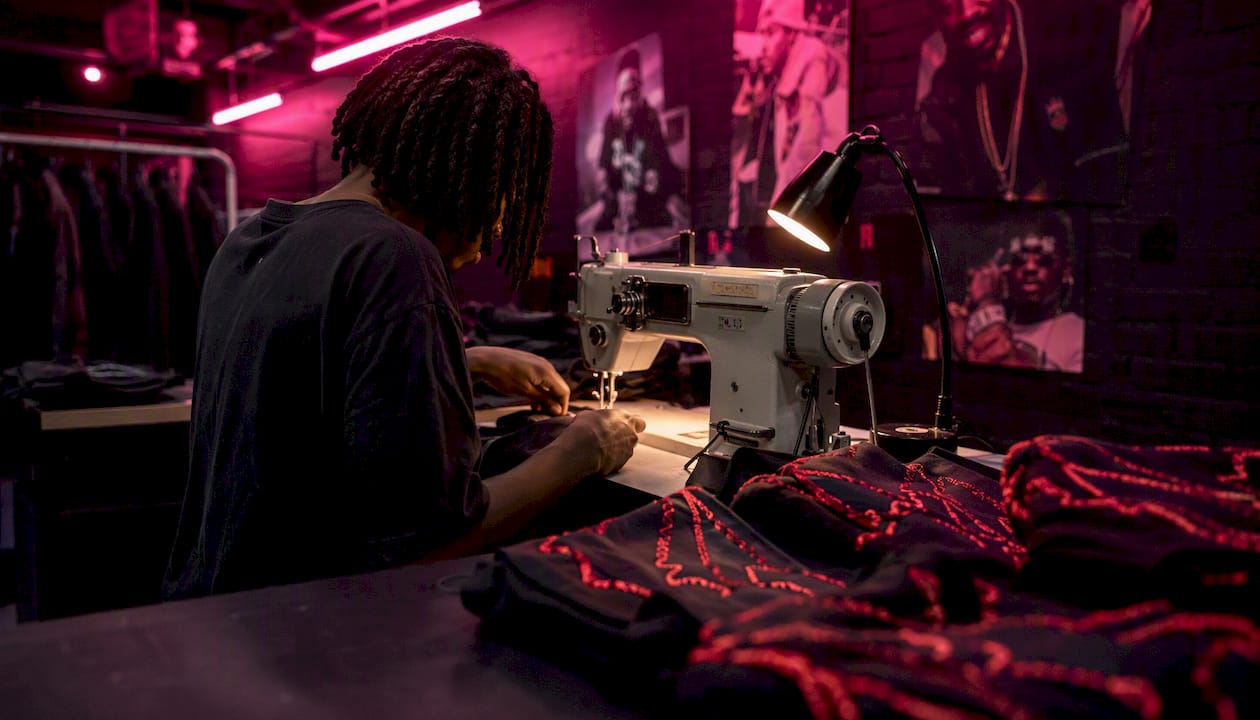
Pro Tip: Stage your first drop small on purpose. Selling out 75 units builds more credibility than moving 40 of 200. Scarcity that's real feels better than scarcity that's accidental.
Operationally, plan for customer service volume around sellouts. A clear FAQ on your site about fulfillment timelines prevents most support tickets before they arrive.
How to tease and promote a merch drop
Tease tactics that consistently work:
- Countdowns: a 72-hour or 48-hour countdown on Instagram Stories and TikTok primes buyers and filters casual followers from serious ones
- Behind-the-scenes content: show the sample, the packaging, the design process — partial reveals build curiosity without giving everything away
- Early-access lists: presale codes distributed via email or SMS reward subscribers and drive list signups in the weeks before launch
- Influencer seeding: send product to a small number of trusted voices 5–7 days before launch so organic content hits the day of the drop
Channel sequencing matters. Queue-it's research confirms that teaser phases starting several days before launch consistently outperform same-day announcements. A rough sequence:
- 2–3 weeks out: announce the drop is coming, no product details yet
- 1 week out: first product tease (color, silhouette, partial image)
- 48–72 hours out: full reveal, early-access window opens for subscribers
- Launch day: public drop goes live, last-hour urgency push via SMS
- Post-drop: thank-you content, fulfillment updates, waitlist capture for next drop
Metrics worth tracking: email open rate on the teaser sequence, clickthrough rate to the product page, and conversion rate during the drop window itself. Those three numbers tell you whether your audience is engaged, curious, and ready to buy.
Real-world examples and what they teach
Cactus Jack (Travis Scott) — The Odyssey x IMAX capsule This streetwear capsule used a strict one-week availability window and a price ladder across items, making the drop accessible at entry level while keeping premium pieces exclusive. The lesson: tiered pricing lets more fans participate without flattening the exclusivity signal.
Wendy's Rewards Drops Wendy's ran weekly members-only drops with narrow windows exclusively for app members. The lesson: loyalty-gated drops reward your most engaged customers and drive app adoption simultaneously.
Panda Express — Pei Pei blind boxes Panda Express released limited-edition blind boxes on Panda Cares Day, donating net proceeds to Panda Cares. The lesson: a drop tied to a cause generates PR, community goodwill, and sales at the same time.
Secret Lair / Magic: The Gathering — Superdrops Magic serializes drops across multiple phases with pre-reveal content and sign-up windows. The lesson: staggered reveals keep the community engaged across weeks, not just hours.
Little Sleepies — weekly pattern drops Little Sleepies runs recurring pattern drops that sell out within minutes, fueled by a strong social presence. The lesson: consistent cadence trains your audience to show up on schedule.
Amaribandz — independent artist drops Amari Bandz uses email and SMS early access to give subscribers first rights on limited apparel and phygital music cards that unlock exclusive tracks. Small, intentional runs keep the community tight and the product meaningful. The lesson: for an independent artist, a drop is less about volume and more about deepening the relationship with fans who actually show up.
What can go wrong with a merch drop?
Supply-side risks:
- Underestimating demand: selling out in two minutes sounds great until half your audience couldn't get through checkout
- Overestimating demand: ordering 500 units when your audience would support 100 ties up cash and creates a fulfillment headache
- Quality failures: a sample that looked fine in photos but arrives with off-center prints or thin fabric damages trust fast
Reputation risks:
- Fake scarcity: announcing restocks after claiming limited supply is one of the fastest ways to lose community trust, as drop culture research consistently shows
- Inconsistent storytelling: a drop that doesn't connect to anything — no narrative, no reason for the timing — reads as a cash grab
Customer experience risks:
- Site crashes: if your store runs on a shared hosting plan, a traffic spike on drop day will take it down. Test load capacity or use a queue system.
- Long fulfillment times: fans who pay a premium for a limited item expect fast shipping. Communicate timelines clearly upfront.
Red flags that mean you should delay a drop:
- Samples haven't been approved
- Your email/SMS list is under 200 subscribers
- You have no teaser content ready
- Fulfillment logistics aren't confirmed
Why I run drops instead of just selling merch
Drops changed how I think about merch entirely. A standard store listing sits there. A drop is an event — fans mark their calendars, they tell their friends, they screenshot the countdown. That energy is real, and it translates directly into the kind of fan loyalty that keeps people coming back for the next release, not just the next purchase.
The tactic I rely on most is simple: email and SMS subscribers get 48-hour early access before anything goes public. That list is the most valuable thing I've built. It rewards the fans who actually opted in, and it gives me a direct line that no algorithm can cut off.
The balance I try to hold is between scarcity and fairness. Limiting a run to 75 units means some fans miss out, and that's a real cost. My answer is transparency: I announce the quantity upfront, I don't restock, and I run another drop when the moment is right. Fans respect honesty about limits more than they resent missing a drop.
Amaribandz drops: how to get early access
Amaribandz releases limited apparel, accessories, and phygital music cards directly to fans — no middleman, no algorithm deciding who sees it first. The merch connects directly to the music, so each drop has a reason to exist beyond just selling a tee.
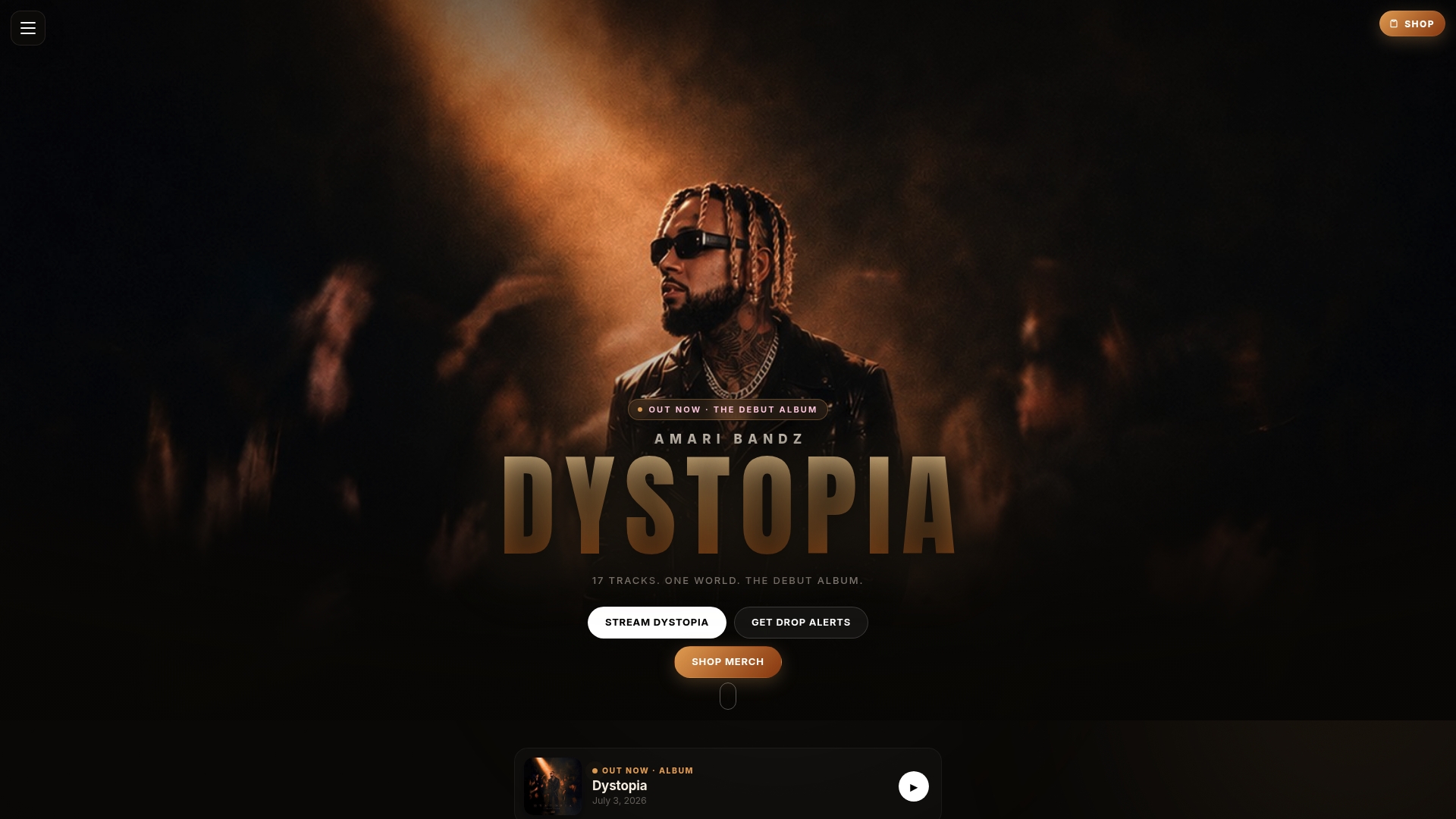
The fastest way to get in is to join the email and SMS list at Amaribandz before the next drop goes live. Subscribers get 48-hour early access, first look at new designs, and direct updates on upcoming releases including new tracks and tour announcements. Browse current merch and sign up at Amaribandz — the next drop won't wait.
Sources
- Product Drops: 8 Strategies, 5 Benefits & 27 Examples (2026)
- More Retailers Look to Manufacture Excitement With Product ‘Drops’ - The New York Times
- Unbox Good Fortune: Panda Express® Drops Limited-Edition Blind-Box Collection Starring Pei Pei
- What is a Merch Drop? (Kontentino explainer)
- Limited drops (Shopify blog)
- Wendy’s Rewards Drops — Wendy’s Blog
- Cactus Jack's The Odyssey x IMAX apparel capsule (Decked Out Magazine)