
Yes, a smaller group of true fans who each spend a significant amount per year can sustain an independent creator. The math is straightforward: fewer fans require higher per-fan spending to reach a sustainable revenue. That single equation, popularized by Kevin Kelly and later sharpened by the venture firm a16z, reframes how independent artists and entrepreneurs should think about audience size. Amaribandz, the hip-hop artist behind DYSTOPIA, is a working example of this model in action, building direct-to-fan revenue through music, merch, and exclusive updates rather than chasing streaming numbers.
| Scenario | Fans Needed | Avg. Annual Spend/Fan | Gross Revenue |
|---|---|---|---|
| High-value superfan model | 125 | $1,000 | $100,000 |
| Mid-tier subscription model | 250 | $400 | $100,000 |
| Low-ticket mass model | 555 | $180 | $100,000 |
The table above makes one thing clear: fewer fans necessitate higher per-fan value. That means your offer design matters more than your follower count.
Pro Tip: Before you build any offer, capture contact data. An email list or SMS subscriber you own is worth ten times a social media follower you don't. Platform algorithms change; your list doesn't.
Table of Contents
- Where did the 100 true fans idea come from?
- How does the math actually work for 100 fans?
- What does a true fan actually look like?
- How do you convert followers into 100 paying true fans?
- Which channels and tools should U.S. creators use?
- How long does it realistically take to reach 100 true fans?
- How could Amari Bandz reach 100 true fans?
- What KPIs should you track and how do you improve them?
- Key Takeaways
- The 100-fan model is real, but it's not passive
- Amaribandz is a live example of the direct-to-fan model
- Sources and further reading
Where did the 100 true fans idea come from?
Kevin Kelly published "1,000 True Fans" in 2008, and it changed how independent creators think about sustainability. His thesis was clean: you don't need millions of fans. You need 1,000 people who will buy everything you make, follow you wherever you go, and spend roughly $100 per year directly with you. That's $100,000 gross, enough to make a living.
Two criteria anchor the whole model. First, the relationship must be direct — no label, no retailer, no algorithm standing between you and the fan. Second, the spend must be annual and intentional, not a one-time purchase. Kelly wasn't describing casual listeners or occasional buyers. He was describing people who pre-order, who show up to the small venue, who buy the signed print.
The a16z reframing came later. The firm's analysis argued that many creators can aim for fewer, higher-value fans instead of many low-value ones. That shift sounds minor, but it changes everything about offer design. Instead of selling a $15 album to a thousand people, you build a product suite that a single devoted fan can spend $1,000 on across a year: a membership, a limited merch drop, a VIP experience, a digital download bundle.
- 2008: Kevin Kelly publishes "1,000 True Fans" on The Technium
- 2020 onward: a16z and creator-economy analysts reframe the model around 100 high-value fans
- 2022–2026: platforms like Patreon, Substack, and Bandcamp make direct monetization practical at small scale
- Now: independent artists like Amaribandz apply the model through direct merch, email/SMS lists, and streaming-linked fan funnels
Smaller pools of high-value fans reduce the acquisition burden but raise the bar on what you deliver. Each fan expects more utility, more exclusivity, and more of you.
How does the math actually work for 100 fans?
The formula is simple: Required fans = Annual revenue target ÷ Average annual profit per fan. The hard part is protecting profit per fan after platform fees, payment processing, and fulfillment costs eat into gross revenue.

| Revenue Target | Avg. Spend/Fan | Platform/Fee Cut (est.) | Net/Fan | Fans Needed |
|---|---|---|---|---|
| $100,000 | $1,000 | ~20% | $800 | 125 |
| $100,000 | $500 | ~20% | $400 | — |
| $100,000 | $200 | ~15% | $180 | — |
Notice that the 100-fan model requires roughly 125 fans, not 100, once you account for a realistic 20% blended fee across payment processing (Stripe charges 2.9% + $0.30 per transaction), platform cuts (Patreon takes 5–12% depending on tier), and merchandise margins. That's still a manageable number.
A hybrid offer mix is where most creators actually land. Say a fan buys a $15/month membership ($180/year), two limited merch drops at $60 each ($120/year), and a $200 VIP ticket to a small live event. That's $500 per fan per year from four touchpoints. Double the high-ticket item to a $400 signature experience and you're at $700. Add a $300 annual bundle and you've crossed $1,000 without a single transaction feeling like a big ask.
The revenue model becomes fragile when it relies entirely on low-priced items. A $10 album and a $20 T-shirt will never get a fan to $1,000 per year. You need at least one high-ticket offering — a signature program, a VIP experience, an annual bundle — to anchor the math.
Pro Tip: Run your numbers with a 20–25% fee buffer before you set prices. If your target is $100K net, price for $125K gross. Adjust per platform based on actual fee schedules.
What does a true fan actually look like?
A true fan isn't someone who liked your last post. Four measurable behaviors separate a true fan from a casual follower: consistent direct purchases, active response to direct outreach, following your recommendations, and unpaid advocacy (telling others without being asked).
| Behavior | Weak Signal | Strong Signal | KPI to Track |
|---|---|---|---|
| Purchasing | One-time buy | Repeat buyer, 2+ transactions/year | Repeat-purchase rate |
| Engagement | Likes a post | Opens emails, replies to SMS | Email open rate, click rate |
| Advocacy | Tags you occasionally | Refers paying friends | Referral rate |
| Loyalty value | Low LTV | High LTV, buys across tiers | LTV per customer |
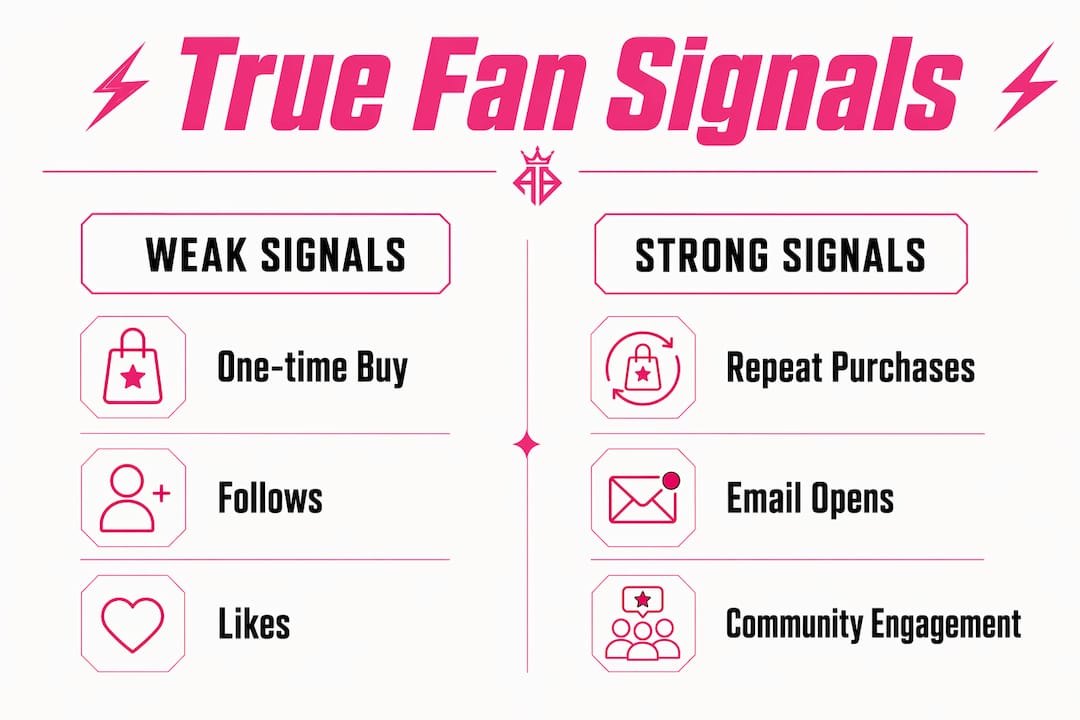
Public metrics — follower counts, likes, view counts — are poor proxies for any of this. A creator with 50,000 Instagram followers and a 0.5% email open rate has a weaker true-fan base than one with 800 email subscribers and a 42% open rate. Owned channels are the only way to actually measure loyal behavior because they give you direct contact data and purchase history.
The loyalty ladder looks like this in practice: a person hears your music on Spotify, follows you on Instagram, then signs up for your email list after seeing a post about an exclusive drop. They buy a $30 T-shirt. Three months later they buy a $60 limited hoodie. Six months in, they buy a $180/year membership. That person is now a true fan candidate. They've shown repeat purchase behavior, they're on your owned list, and they're spending across tiers.
miss these signals entirely. Store purchase history, email engagement, and referral events in a simple CRM or even a spreadsheet. Those signals tell you who to invite to higher-tier offers.How do you convert followers into 100 paying true fans?
The offer stack is everything. A single product at a single price point will not get a fan to $1,000 per year. You need multiple entry points at different price levels so fans can spend more as their trust deepens.
- Entry-level: digital downloads, single merch items, or a free email/SMS list ($15–$60 per transaction)
- Mid-tier: monthly or annual memberships with exclusive content, early access, or community access ($10–$25/month, or $100–$200/year)
- High-ticket: VIP event tickets, signed bundles, limited-run collectibles, or annual signature packages ($200–$500+)
- Top tier: one-on-one access, private listening sessions, co-creation experiences, or premium annual bundles ($500–$1,000+)
Retention is where most creators underinvest. Acquiring a new customer costs 5–25 times more than retaining an existing one. That math alone makes onboarding rituals worth building. When someone joins your email list or buys their first item, send a personal welcome. Tell them what's coming. Give them something they didn't expect — a bonus track, a behind-the-scenes video, a discount code for their next purchase.
Loyalty is an engineered system, not a vibe. Design repeatable reward loops: a cue (new release announcement), a routine (exclusive early access for list members), a reward (the drop itself), and reinforcement (a thank-you message or community shoutout). Fans who experience this loop consistently become the people who tell their friends.

Scarcity works when it's real. Limited-run merch drops with a genuine cap, VIP tickets with a hard seat count, and time-limited bundles all create urgency without feeling manipulative. The key is following through: if you say 50 units, stop at 50.
Pro Tip: Build a fan subscription model before you need it. A $10/month tier with exclusive content gives you predictable monthly revenue and a pool of warm buyers for every high-ticket offer you launch.
Which channels and tools should U.S. creators use?
Email and SMS are the backbone. Social platforms are distribution channels, not destinations. When Instagram changes its algorithm or TikTok faces regulatory pressure, creators who built their audience on owned contact data keep their revenue. Those who built only on platform followers start over.
| Channel Type | Best For | U.S. Tools | Fee Notes |
|---|---|---|---|
| Nurturing, announcements, offers | Mailchimp, ConvertKit, Klaviyo | Free tiers available; paid from ~$15/month | |
| SMS | High-open-rate alerts, drops | Klaviyo, Postscript, Community | Per-message fees; 20% blended fee estimate |
| Subscription platforms | Recurring revenue, community | Patreon, Substack | 5–12% platform cut |
| E-commerce / merch | Direct sales, fulfillment | Shopify, Gumroad, Bandcamp | 2.9%–10% transaction fees |
| Ticketing | Live events, VIP experiences | Eventbrite, Dice | 20% blended fee estimate |
| Payment processing | Direct checkout | Stripe, PayPal | 2.9% + $0.30/transaction |
- Owned channels first: email and SMS give you direct contact and the highest conversion rates for offers
- Subscription platforms second: Patreon and Substack handle recurring billing and community features, but take a cut
- E-commerce for physical goods: Shopify works for higher-volume merch; Gumroad and Bandcamp suit smaller catalogs with lower overhead
- Ticketing for live events: dynamic ticket pricing strategies can significantly increase revenue per seat for micro-events and VIP tiers
For tool selection, prioritize four factors: scale (does it handle your current size without overcharging?), fees (what's the blended cost at your revenue level?), integration (does it connect to your email platform?), and fan friction (how many clicks does a fan need to buy?). Every extra step in the checkout flow costs you conversions.
For platform alternatives that reduce lock-in risk, fan platform options have expanded significantly, giving creators more flexibility than the Patreon-or-nothing era.
How long does it realistically take to reach 100 true fans?
The honest answer: 12–24 months for most independent creators starting from a small but real audience. Best-case scenarios with an existing engaged list and a strong first offer can compress that to 6–9 months. Starting from zero with no list and no product takes longer.
Here's a realistic milestone sequence:
- Month 1–2: Build the foundation. Set up email capture, launch one entry-level offer, and post consistently on one or two platforms to drive list growth.
- Month 3–4: Identify your first 10 true fan candidates from purchase history and email engagement. Invite them personally to a mid-tier offer or a beta membership.
- Month 5–6: Launch a formal membership or subscription tier. Aim for 25–30 paying members.
- Month 7–9: Add a high-ticket offer (VIP event, annual bundle, limited merch drop). Existing members are your first buyers.
- Month 10–12: Review LTV per fan, retention rate, and repeat-purchase rate. Identify your top 20% of buyers and design offers specifically for them.
- Month 13–24: Scale acquisition while protecting retention. You should be approaching 75–100 true fans by month 18 if conversion rates hold.
Weekly time budget for a solo creator: roughly 5–8 hours per week across content creation (2–3 hours), community management and direct outreach (1–2 hours), offer fulfillment and logistics (1–2 hours), and analytics review (30 minutes). That's a part-time job, not a side hobby.
True fans are a rotating resource. Life changes, interests drift, and some fans will leave even if you do everything right. Expect annual attrition and budget for ongoing acquisition. Reaching 100 true fans is not a finish line; it's a steady state you maintain.
A 30-day experiment cadence works well for iteration: define your promise, publish consistently, add one community ritual, collaborate with one other creator, then review what moved the needle. Roll the winners into your standard operations.
How could Amari Bandz reach 100 true fans?
Amaribandz already has the structural pieces in place: a direct-to-fan website, a merch storefront, streaming distribution across major platforms, and tracks with real audience pull ("Japan," "Beautiful High," "Currency"). The gap for most independent artists at this stage is converting passive listeners into paying, identified fans.
Here's a campaign structure that fits the Amaribandz model:
- Set up email/SMS capture on the artist landing page with a clear incentive: early access to new releases, exclusive lyrics, or a discount on the first merch order.
- Launch a $15/month fan membership with three benefits: exclusive track previews, member-only merch discounts, and a monthly Q&A or behind-the-scenes update.
- Run two limited merch drops per year at $60–$80 per item, announced first to email/SMS subscribers. Cap each drop at 150 units to create genuine scarcity.
- Host one small VIP event per quarter — a listening session, a private performance, or a meet-and-greet — ticketed at $150–$200. Even 20 attendees per event generates $3,000–$4,000 per quarter.
- Use streaming platforms as the top of the funnel, not the revenue engine. Every Spotify listener is a potential email subscriber; every email subscriber is a potential merch buyer; every merch buyer is a potential membership member.
| Offer | Price | Annual Value/Fan | Fans Needed for $100K |
|---|---|---|---|
| Membership only | $180/year | $180 | — |
| Membership + 2 merch drops | $180 + — | $500 | — |
| Membership + merch + 1 VIP event | $500 + $175 | — | — |
| Full suite (above + annual bundle) | — + $300 | — | 126 |
With a full offer suite, Amaribandz needs roughly 126 fans spending across all tiers to net $100,000 after fees. That's achievable within 18–24 months with consistent content, direct outreach to engaged listeners, and a fan community that gives members a reason to stay.
The conversion funnel assumption: if 5% of email subscribers convert to paying members and 20% of members upgrade to a VIP experience, you need roughly 2,500 email subscribers to generate 125 paying true fans. That's a realistic list size for an independent artist with active streaming presence and consistent social content.
What KPIs should you track and how do you improve them?
Five metrics tell you almost everything you need to know about your true-fan program's health:
- LTV per fan: total revenue per customer over 12 months. Target: $500+ for a mid-tier program, $1,000+ for a full suite.
- Retention rate: percentage of paying members who renew or stay active after 90 days. A healthy rate is above 70%.
- Repeat-purchase rate: percentage of buyers who make a second purchase within 6 months. Below 20% signals weak offer design or poor onboarding.
- Email open rate: industry average for creator newsletters runs 30–40%; if you're below 25%, your subject lines or send frequency need work.
- Referral rate: how many new buyers came from an existing fan's recommendation. Even a 5–10% referral rate meaningfully reduces acquisition cost.
When your sample size is small (under 50 fans), don't over-index on percentages. One churned member in a group of 20 is a 5% churn rate, but it might just be one person who moved cities. Look for patterns across 2–3 months before changing your offer or pricing.
A prioritized experiment list for the first 90 days:
- Test your onboarding sequence: send a 3-email welcome series to new subscribers and measure open rates. A strong welcome series can lift first-purchase conversion by a meaningful margin.
- Test one price point: offer a limited-time annual membership at a discount and measure upgrade rate from monthly members.
- Test a referral incentive: give existing members a unique discount code to share. Track how many new buyers use it.
- Test content format: alternate between behind-the-scenes updates and direct offers in your email cadence. See which drives more clicks to your store.
Measured loyalty requires owner-controlled tracking. A simple spreadsheet with columns for subscriber date, first purchase date, total spend, and last engagement date is enough to identify your top fans and invite them to higher-tier offers. You don't need enterprise software to run this at 100-fan scale.
Pro Tip: Set a 90-day review date on your calendar now. At that date, pull your LTV, retention, and repeat-purchase numbers. Pick the one metric furthest from your target and run one focused experiment on it for the next 30 days.
Key Takeaways
Building about 125 true fans works when each fan spends $1,000 per year across a tiered offer suite, which means offer design and audience ownership matter far more than follower count.
| Point | Details |
|---|---|
| The core math | 125 fans × $800/year net after platform fees = $100,000 net; budget a 20–25% fee buffer for net targets. |
| Owned channels first | Email and SMS lists are the only audience you control; prioritize them over social followers. |
| Offer suite design | A single low-priced item never reaches $1,000/fan/year; build tiers from entry-level to high-ticket. |
| Measure what matters | Track LTV, retention rate, and repeat-purchase rate — not likes or follower counts. |
| Amaribandz model | Amaribandz combines music, merch, and exclusive updates in a direct-to-fan structure that maps directly onto the 100-fan revenue model. |
The 100-fan model is real, but it's not passive
The idea that 100 people can sustain a creative career sounds almost too clean. And in practice, it is a little messier than the math suggests. What the model gets exactly right is the direction: depth over breadth, owned relationships over platform reach, high-value offers over high-volume sales. That reorientation alone is worth more than any specific tactic in this article.
What it undersells is the ongoing work. True fans churn. People move, tastes shift, life gets in the way. The creator who reaches 100 true fans and then stops acquiring new ones will find themselves at 80 fans a year later, then 65. The model requires a permanent top-of-funnel effort running alongside retention work. That's not a flaw in the theory; it's just the reality of any subscription or loyalty business.
The emotional side is also real. Building a small, intense fanbase means you're visible to people who genuinely care what you do next. That's creatively freeing and occasionally terrifying. When you evolve publicly, some fans follow and some don't. The ones who stay are worth more than the ones who leave, but losing them still stings. Treat loyalty as a system you design and measure, not a feeling you hope to generate. The creators who sustain themselves over years are the ones who engineer the conditions for loyalty rather than waiting for it to happen organically.
Amaribandz is a live example of the direct-to-fan model
The 100-fan model isn't theoretical for Amaribandz. The artist's direct-to-fan platform connects music, merch, and exclusive updates in exactly the structure this article describes: streaming as the top of the funnel, merch as the first paid touchpoint, and email/SMS as the owned channel that ties it together.

If you want to see the model in action before you build your own version, start at the Amaribandz landing page. The discography, merch store, and fan update system are all live. Sign up for updates, buy a piece of merch, and watch how the direct-to-fan funnel works from the inside. That's the fastest way to understand what you're building toward.
Sources and further reading
- Kevin Kelly, "1,000 True Fans" — The Technium, 2008: The original essay that started the conversation about sustainable creator economics through direct fan relationships.
- Kevin Kelly, "The Case Against 1,000 True Fans" — The Technium: Kelly's own honest follow-up examining real-world data and the limits of the model.
- a16z, "1,000 True Fans? Try 100": The venture firm's reframing toward 100 high-value fans and higher-ticket offer design.
- Secret O.W.L. Society, "The 6-Figure Power of 100 True Fans": A practitioner's breakdown of how the $1,000 product suite math works for independent creators.
- Beehiiv, "How to Build a Fanbase": Operational definition of true-fan behaviors and practical acquisition tactics.
- Jessica Abel, "1,000 True Fans + 1 Elephant in the Room": A candid look at why owned audience channels (email/SMS) are the missing piece in most creator strategies.
- InfluencerDB, "Build a Loyal Audience: Science-Backed Growth Playbook": Research-backed framework for designing loyalty systems and measuring retention.
- Amaribandz — Artist Landing Page: Direct-to-fan platform with music, merch, and exclusive updates — a live implementation of the 100-fan model.