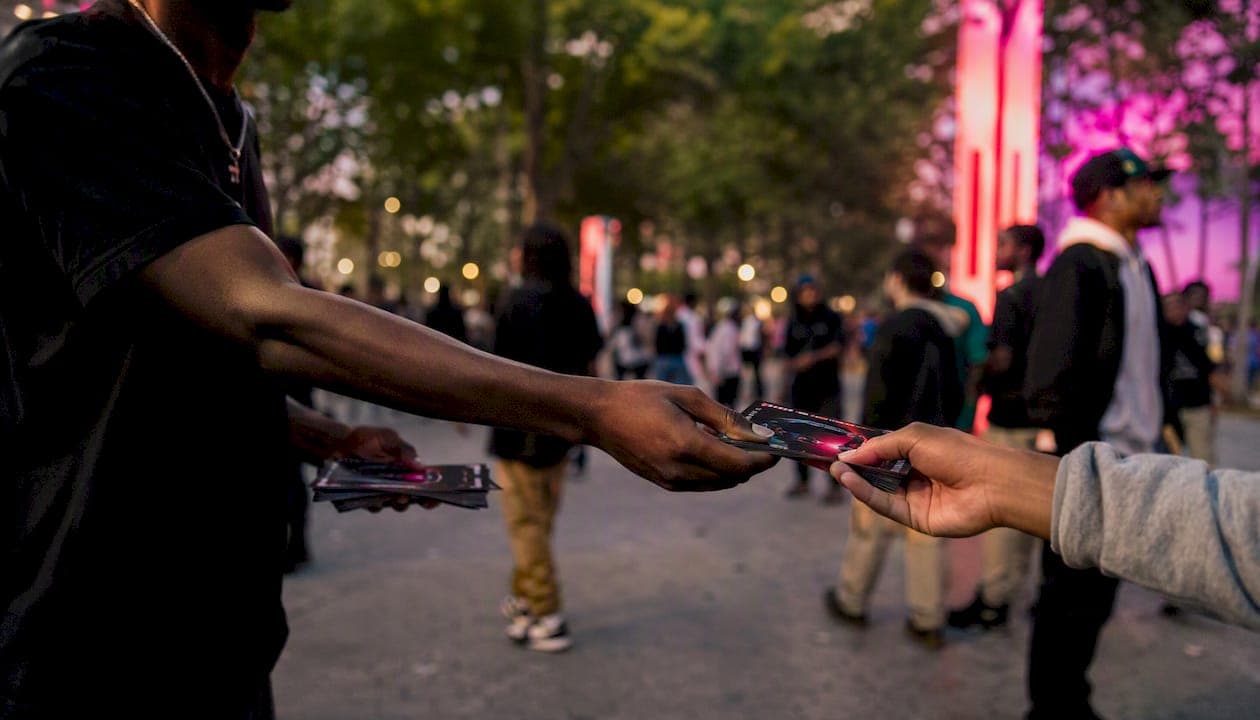
A street team is a group of people who promote an artist, author, or brand directly to local communities, whether by handing out flyers, sharing posts, or spreading word-of-mouth at events. An indie musician might recruit ten local fans to plaster posters before a show; an author might build a reader street team to post early reviews and push a book launch on social media. For an independent hip-hop artist like Amaribandz, a street team is often the difference between a release that lands and one that disappears.
Key Takeaways
A street team is a group of fans or trained ambassadors who promote an artist or author directly to local communities, using both physical and digital tactics to capture leads and build genuine word-of-mouth.
| Point | Details |
|---|---|
| Core definition | A street team promotes a brand, artist, or author through direct community outreach, online and offline. |
| Three main models | Fan-volunteer, professional ambassador, and hybrid; choose based on budget, scale, and measurement needs. |
| Compensation basics | Most music teams reward with merch, tickets, or early access; cash payments above $600 require W-9 and 1099-NEC filing. |
| Tracking is non-negotiable | Assign unique short links or promo codes per member to connect activity to real outcomes like signups and sales. |
| Start small | A pilot of five to ten volunteers with one clear goal produces more usable data than a large, untracked rollout. |
Table of Contents
- Where did street teams come from?
- Who joins a street team and what do they actually do?
- What models exist for running a street team?
- How do you build and run a street team step by step?
- Do street teams get paid, and what are the legal basics?
- How do street teams work in 2026?
- How do you measure whether your street team is working?
- How Amaribandz could use a street team for a new release
- Why street teams still matter more than most artists realize
- Sources
Where did street teams come from?
Street teams grew out of the music industry in the 1970s and 1980s, when independent labels needed cheap, credible ways to build local buzz. Record labels would recruit dedicated fans and local tastemakers, people with real influence in their neighborhoods, to post flyers, talk up records at clubs, and push cassettes into the right hands. These early tastemakers were the original multiplier: their credibility converted into local momentum faster than any ad buy could.
By the 1990s and early 2000s, major labels had formalized the model. Hip-hop labels in particular leaned on street teams to move units in specific cities before national rollouts. What started as informal fan networks gradually professionalized into structured brand ambassador programs, with clear tasks, reporting, and non-cash rewards. Brands outside music noticed, and the model spread to consumer goods, film, and events.
Who joins a street team and what do they actually do?
Street teamers come from a few distinct profiles:
- Dedicated fans who want closer access to an artist or author and are willing to work for it
- Fan-club volunteers who already run community pages or local meetups
- Paid brand ambassadors hired through agencies or directly by a label or publisher
- Campus or neighborhood tastemakers with organic influence in a specific area
Day-to-day tasks vary by campaign, but the core activities look like this:
- Distributing physical promo materials (flyers, stickers, posters) in agreed locations
- Sharing posts, pre-save links, or trailers across personal social accounts
- Attending events and directing foot traffic or capturing email signups
- Collecting lead data via QR codes, short links, or paper sign-up sheets
- Reporting back on what messaging and materials got the best response
Street team volunteers in music are typically compensated with non-monetary rewards rather than pay, a point worth understanding before you recruit or sign up. The role of a social sharer differs from an event outreach rep, and a data collector has different expectations than a neighborhood poster-runner. Knowing which role you need, or want, shapes everything from recruiting to onboarding.
What models exist for running a street team?
Three models dominate, each with real trade-offs.
Fan-volunteer model: Low cost, high authenticity, and genuinely hard to fake. Fans who love your music or book bring credibility that a hired rep simply cannot replicate. The downside is consistency: volunteer availability fluctuates, and tracking activity requires extra effort. Author and music street teams built on volunteers work best for grassroots launches where trust and word-of-mouth matter more than scale.
Professional brand-ambassador model: Trained staff deployed to high-traffic locations with measurable goals, qualifying purchase intent, and capturing contact information. According to Street Teams Co, modern professional street teams are distinct from booth staff (fixed-location) and sampling staff (volume-driven): street teams are mobile and relationship-driven, with different training and ROI expectations. This model costs more but produces predictable KPIs.
Hybrid model: Combine fan passion with a paid lead-capture layer. Use volunteers for social sharing and local buzz; bring in a small number of paid ambassadors for events where data collection and conversion matter. This is the most practical choice for independent artists who want both authenticity and measurement.
| Model | Cost | Authenticity | Consistency | Best for |
|---|---|---|---|---|
| Fan-volunteer | Low | High | Variable | Grassroots launches, tight budgets |
| Professional ambassador | Medium-High | Moderate | High | Events, measurable ROI campaigns |
| Hybrid | Medium | High | Moderate | Independent artists scaling up |
How do you build and run a street team step by step?
A reproducible process matters more than enthusiasm. Here is a checklist that works for music and book campaigns alike.
- Define your goal first. Are you building an email list, driving pre-saves, selling merch, or filling a show? The goal determines every other decision.
- Recruit from your existing community. Post in your fan group, Discord server, or email list. Campus bulletin boards and local music scenes are strong offline channels. Look for people who already talk about you without being asked.
- Onboard with a clear mission brief. Give every team member a one-page document: what the campaign is, the key talking points, what they should and should not say, and where to send leads. Include brand assets (logo files, approved images, short bio).
- Assign specific, trackable tasks. Vague asks produce vague results. "Post about the album" is weak; "share this pre-save link with your caption by Friday and screenshot it to the group chat" is trackable.
- Set up tracking tools before launch. Create unique short links (Bitly or a similar tool) for each team member, or assign individual promo codes. Use a simple Google Form or Airtable sheet to collect daily or weekly reports.
- Communicate on a regular cadence. A weekly group message with results, shout-outs, and the next task keeps momentum alive. Dead air kills volunteer motivation fast.
- Reward consistently and publicly. Announce who hit their targets. Deliver merch, tickets, or early access on time. Delayed rewards signal that the team is not a priority.
Pro Tip: Gamify the tasks. Assign points for each completed action (10 points for a post, 25 for a confirmed email signup, 50 for attending an event). Redeem points for tiered rewards: a signed poster at 100 points, a soundcheck pass at 300. Tiered, exclusive rewards increase engagement and retention far more than a flat "thanks" ever will. For ideas on fan experiences that build loyalty, the Amaribandz blog has practical examples.
Do street teams get paid, and what are the legal basics?
Most music and book street teams run on non-monetary compensation. Merch, tickets, early access to unreleased tracks, signed copies, and soundcheck passes are the standard currency. This keeps costs low and, when the rewards are genuinely exclusive, often motivates fans more than a small cash payment would.
When you do pay team members, U.S. tax rules apply. If you pay an individual $600 or more in a calendar year for services, you are generally required to collect a W-9 and issue a 1099-NEC at year-end. Payments below that threshold still represent taxable income for the recipient, even if you are not required to report them.
On the ground, local permit rules matter. Many U.S. municipalities require permits for flyering on public property or door-to-door solicitation. Rules vary significantly by city and county, so check with your local government before sending anyone out with a stack of flyers. Posting on private property (stores, venues, coffee shops) requires the owner's permission. Skipping this step risks fines and, worse, a bad look for your brand.
Ethically, be transparent. Team members should disclose their connection to the artist or author when posting online, in line with FTC endorsement guidelines. A quick "I'm on the street team for this release" is all it takes.
How do street teams work in 2026?
Physical flyers still have a place, but data-driven street team marketing now centers on lead capture, short links, and real-time reporting rather than volume distribution alone. The shift is significant: a team member who hands out 200 flyers with no tracking produces no usable data; one who shares a unique QR code that drives 40 email signups produces a list you can market to for years.
Digital extensions that work well alongside physical activity:
- Unique short links or UTM-tagged URLs assigned per team member to track individual contribution
- QR codes on physical materials that route to a pre-save page, email signup, or merch store
- Promo codes that give fans a discount and give you conversion data tied to each team member
- Pre-save link campaigns on streaming platforms to build day-one numbers
- Discord, Telegram, or Facebook group coordination for reader or fan street teams managing social sharing tasks
Fan club apps and platforms now let artists coordinate street-team tasks, distribute assets, and track completions in one place. Micro-influencers, fans with a few thousand engaged followers rather than millions, are increasingly the most cost-effective layer of a hybrid street team because their audiences trust them. Pairing a micro-influencer's social post with a unique promo code connects offline credibility to online conversion in a way that is easy to measure. For artists also building streaming audiences, tying street-team activity to a Spotify marketing strategy creates a compounding effect: local buzz drives streams, streams drive algorithmic placement.
How do you measure whether your street team is working?
Tracking does not need to be complicated. The goal is to connect each team member's activity to a real outcome.
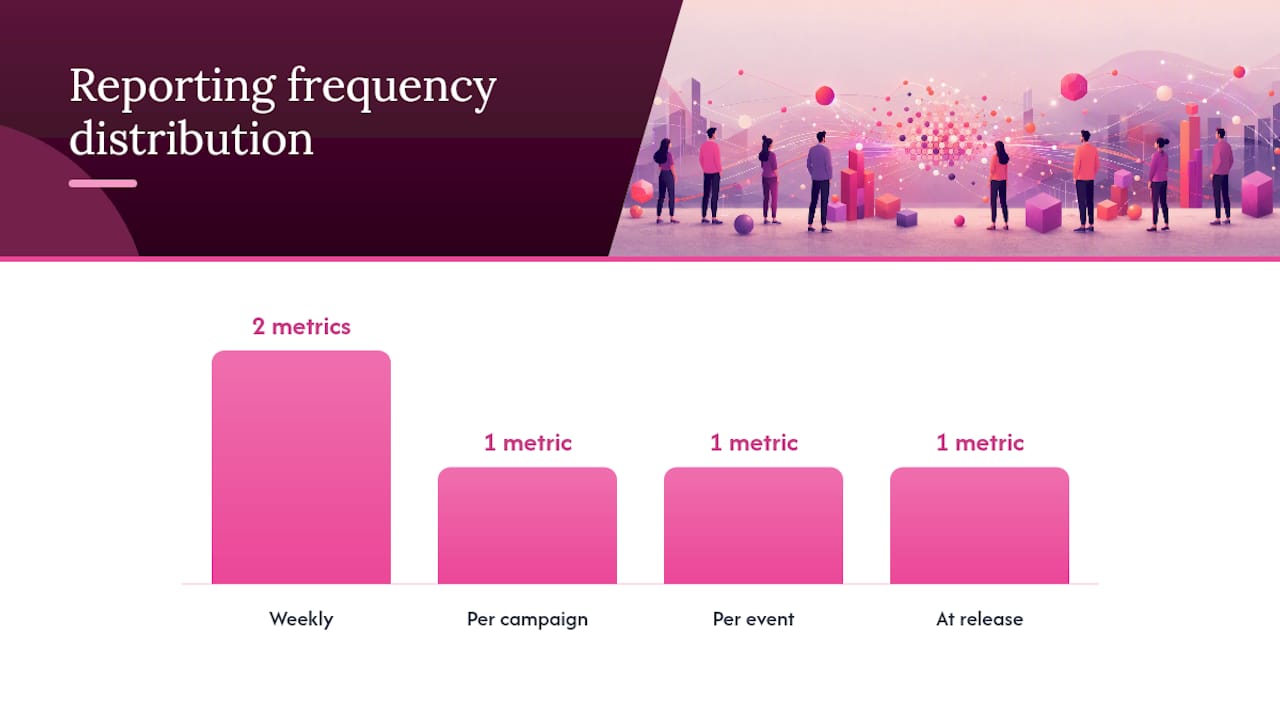
| Metric | How to capture it | Reporting frequency |
|---|---|---|
| Email signups | Unique short link or QR code per member | Weekly |
| Promo code redemptions | Discount code tied to each member | Per campaign |
| Social engagements | Screenshot submissions or social listening tool | Weekly |
| Event attendance lift | Check-in count vs. baseline show attendance | Per event |
| Pre-save or stream count | Streaming platform analytics | At release |
Street teams also function as a feedback loop on the ground: they tell you which songs resonate when played out loud, which merch designs people ask about, and which talking points fall flat. That qualitative intelligence is harder to quantify but often more valuable than the click data. Build a simple weekly debrief question into your team check-in: "What did people respond to most this week?" The answers will shape your next campaign faster than any dashboard.
For artists managing multiple ambassadors at larger events, real-time dashboards and GPS tracking are increasingly standard tools among professional teams. At the independent level, a shared Airtable or Google Sheet with daily updates achieves most of the same visibility at no cost. Fan engagement platforms built for independent artists can also centralize lead capture and reward tracking in one place.
How Amaribandz could use a street team for a new release
Picture a pre-release campaign for a new Amaribandz single. The goal: grow the email list by a targeted number of subscribers and drive pre-saves in the two weeks before drop day.
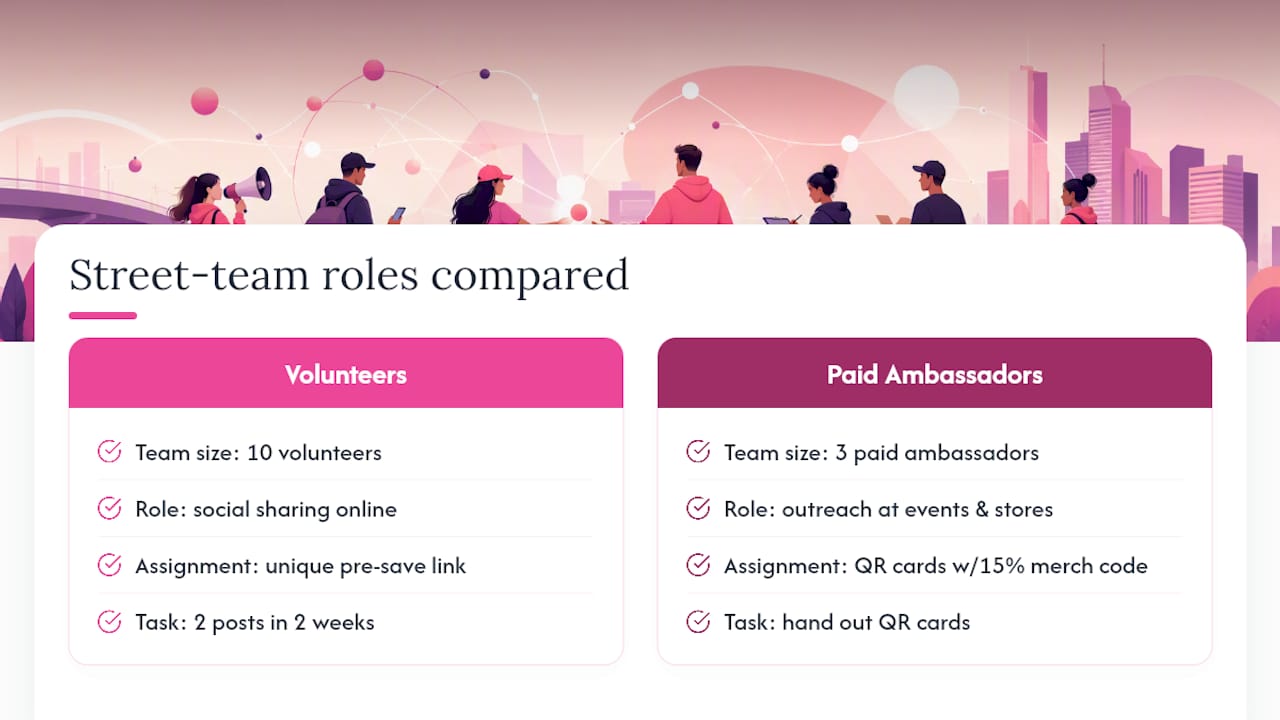
The model is a hybrid. Ten volunteer fans handle social sharing, each assigned a unique pre-save link and asked to post twice in the two-week window. Three paid ambassadors work local events and record stores in the artist's home market, handing out cards with a QR code that routes to the email signup page. Every card also carries a promo code for 15% off merch at Amaribandz, which ties physical distribution directly to revenue.
The fan volunteers get early access to the track before release and a signed sticker pack. The paid ambassadors receive a flat day rate plus a performance bonus for every 10 confirmed signups above a baseline. Weekly check-ins in a group chat keep everyone aligned, and the promo code data shows exactly which ambassadors are converting.
Expected outcomes: a measurable email list, day-one pre-save numbers that signal momentum to streaming algorithms, and a small merch revenue bump. The qualitative win is just as real: the team reports back which venues had the most interest, which talking points landed, and which neighborhoods to prioritize for the next campaign.
Pro Tip: For independent hip-hop, the most effective street-team recruits are fans who already post about you without being asked. Search your artist name on social platforms before you launch any formal recruitment. The people already talking are your first ten team members.
Why street teams still matter more than most artists realize
The conventional wisdom right now is that social media has replaced street teams. Spend on ads, grow your following, let the algorithm do the work. That framing misses something important.
A street team does something no ad can: it puts a real person in front of another real person and says, "I love this, and you should hear it." That transfer of credibility is not scalable in the traditional sense, but it is extraordinarily durable. The fans who get recruited into a street team become the most loyal segment of any artist's audience because they have invested something beyond money. They have given their time and their social reputation.
The data argument is equally strong. A well-run street team captures contact information and behavioral signals that paid social advertising rarely delivers cleanly. An email address collected by a team member at a show is worth more than a thousand impressions on a platform you do not own.
The right move is not to choose between digital and physical. Run a small pilot: five to ten volunteers, one trackable link each, one clear goal. The results will tell you more about your audience than months of passive streaming data.
Sources
- Street team - Wikipedia
- What Is a Street Team? - LiveAbout
- Street Team Marketing: The Complete Guide for 2026 | Street Teams Co
- Street Team Marketing Guide 2026: Proven Strategies
- What Street Team Marketing Is and How to Do It Effectively