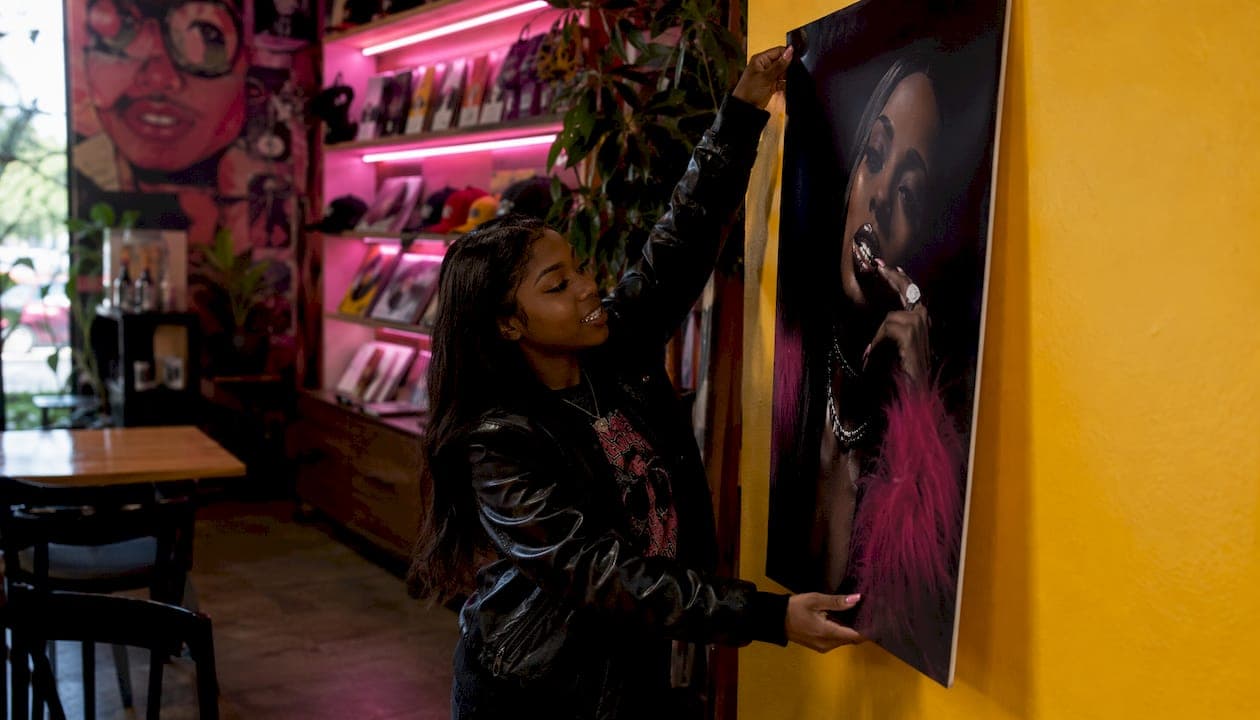
For most fans, the choice comes down to two sizes: 18×24 inches for dorm rooms, bedroom walls, and merch table displays, and 24×36 inches when you want real visual impact across a room. If you're going collector-style with a movie one-sheet format, 27×40 is the one. All three are common U.S. poster sizes that fit standard frames and print sharp at 300 DPI.
Quick picks by scenario:
- Dorm or small bedroom wall: 18×24 in. (fits most standard frames, easy to ship)
- Studio or living room statement piece: 24×36 in. (maximum visual punch)
- Collector or limited-edition one-sheet: 27×40 in. (classic movie-poster format)
- Merch table handout or promo flyer: 11×17 in. (cheap to print in bulk)
Pro Tip: Measure your wall space or frame opening before ordering. A 24×36 poster on a narrow wall can feel cramped fast. Grab a tape measure, not just a guess.
Table of Contents
- What are the standard poster sizes in inches?
- How do A-series sizes compare to U.S. poster formats?
- How does viewing distance help you pick the right size?
- How design complexity should guide your size choice
- What file specs do you need before sending a poster to print?
- How to frame and display your poster without sizing headaches
- What does poster printing cost in the U.S., and how long does it take?
- Key Takeaways
- Why poster size and print quality actually matter for fans
- Official Amari Bandz posters: buy direct and get it right
- Useful sources and next steps
What are the standard poster sizes in inches?
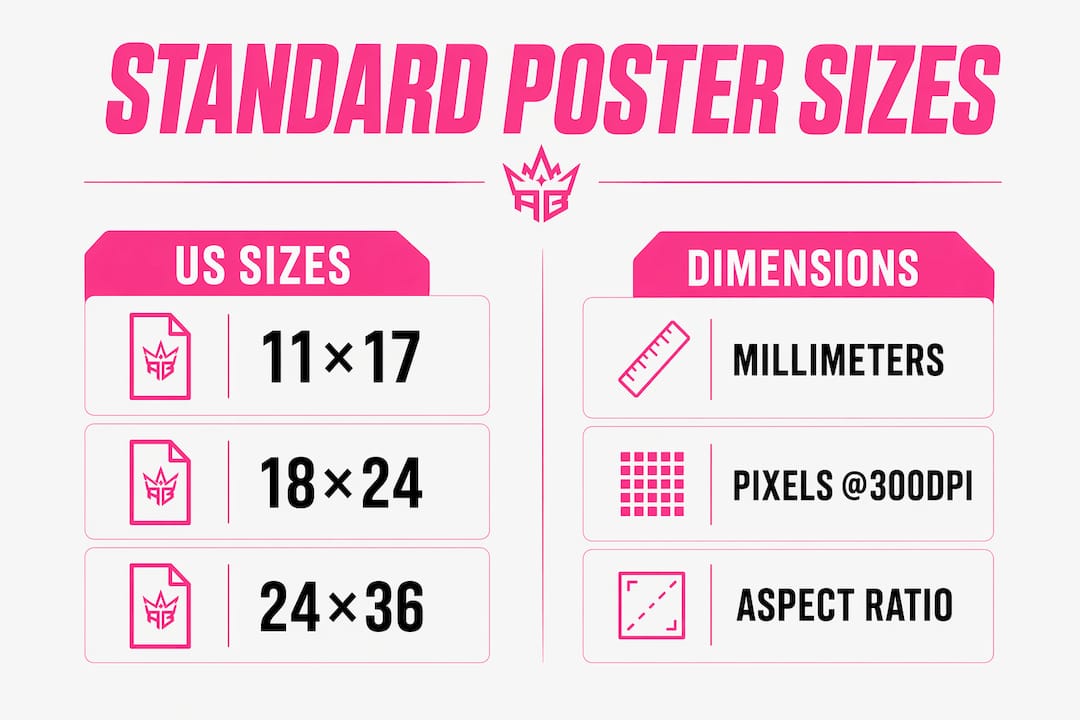
The table below covers every common poster dimension you'll encounter in the U.S., with millimeter equivalents and pixel targets at 300 DPI for print-ready files.
| Size (in) | Size (mm) | Pixels at 300 DPI | Aspect Ratio | Best For |
|---|---|---|---|---|
| 11×17 | — | 3,300×4,800 | 2:3 | Flyers, merch table handouts |
| 18×24 | — | 5,400×7,200 | 2:3 | Small wall art, promo prints |
| 16×20 | — | — | 4:5 | Gallery-style display |
| 18×24 | — | 5,400×7,200 | 3:4 | Dorm walls, retail promotions |
| 24×36 | — | 7,200×10,800 | 2:3 | Concert posters, bedroom walls |
| 27×40 | — | 7,200×10,800 | ~2:3 | Movie one-sheets, collector prints |
| 36×48 | — | 10,800 | 3:4 | Large venue signage |
| 40×60 | — | — | 2:3 | Bus stop, event lobby displays |
The 18×24 and 24×36 formats dominate retail and wall-art printing in the U.S. Aspect ratios matter: a 2:3 design (like 24×36) won't crop cleanly into a 3:4 frame (like 18×24) without adjusting the artwork. Build your file to match the exact ratio of the size you're ordering.
How do A-series sizes compare to U.S. poster formats?
If you're buying frames from an international shop or gifting a print to someone outside the U.S., A-series sizes are what you'll encounter. They follow a √2 (roughly 1:1.41) aspect ratio, which means they don't map perfectly onto U.S. standard frames.
- A3 (297×420 mm / ~11.7×16.5 in): closest to 11×17, but slightly narrower
- A2 (420×594 mm / ~16.5×23.4 in): sits between 16×20 and 18×24; won't fit either U.S. frame without a mat
- A1 (594×841 mm / ~23.4×33.1 in): close to 24×36 but about 3 inches shorter
- A0 (841×1,189 mm / ~33.1×46.8 in): large-format exhibition and billboard use
Before ordering a frame for an A-series print, check the exact millimeter dimensions. A frame sold as "24×36" in the U.S. will not fit an A1 print without a custom mat. The 2.9-inch height difference is enough to buckle or gap the print visibly. When listing merch internationally, include both inches and millimeters so buyers know what they're working with.
How does viewing distance help you pick the right size?
The rule is simple: the farther your audience stands, the larger the poster needs to be. Experts recommend matching size to viewing distance before anything else.
- 1–2 feet away (desk, close wall, merch table): A3 or 11×17 works fine. Detail reads clearly at close range.
- 2–4 feet away (bedroom wall, hallway): 18×24 is the sweet spot. Bold enough to read, small enough to frame easily.
- 3–6 feet away (living room, studio, small venue): 24×36 is the go-to. Text and imagery hold up across the room.
- 5–10 feet away (concert lobby, retail window, event space): 36×48 or larger. Anything smaller disappears at distance.
- 10+ feet away (large venue, outdoor display): 40×60 or custom large format. At this scale, 150 DPI is acceptable since viewers never get close enough to see pixel detail.
Pro Tip: Think about sightlines, not just distance. A poster hung at eye level in a narrow hallway reads differently than one mounted high on a gallery wall. High placement needs larger type and higher contrast to stay readable.
How design complexity should guide your size choice
Simple, bold artwork scales down cleanly. A strong portrait shot or a single graphic with large type works at 11×17 without losing anything. Detailed photo collages, layered backgrounds, or dense credit text need room to breathe, which means 24×36 or larger.
Key layout rules to keep in mind:
- Typography hierarchy: Keep headline type at least 10% of the poster's height. On an 18×24, that's roughly 2.4 inches of headline space.
- Negative space: Don't fill every inch. Breathing room around the main image makes the design feel premium, not crowded.
- Color contrast: Amari Bandz's dark-minimal aesthetic with neon accents reads best when the background is deep and the accent color is used sparingly. Cluttered layouts kill that effect.
- Safe zone: Keep all critical text and imagery at least 0.25 inches from the trim edge, beyond the bleed area.
Pro Tip: Request vector files for logos and large type elements. A vector logo scales from 11×17 to 27×40 without any loss. A rasterized logo at 72 DPI will look soft the moment you print it larger than its source size.
What file specs do you need before sending a poster to print?
Get these right before uploading, or you'll pay for a print that doesn't look the way you expected.
Resolution and pixel dimensions:
- 300 DPI for any poster viewed within 6 feet (18×24 = 5,400×7,200 px; 24×36 = 7,200×10,800 px)
- 150 DPI is acceptable for very large formats (36×48 and up) where viewing distance is 8+ feet
- Never scale up a low-resolution file. Pixelation at print size is permanent.
Bleed, safe area, and color:
- Add 0.125 inches of bleed on every edge beyond the trim line
- Keep all text and key art 0.25 inches inside the trim (the "safe zone")
- Export in CMYK color mode. RGB files shift color when converted at the printer, often making vibrant neons look dull.
- Preferred formats: PDF (press-quality), TIFF (lossless raster), or EPS/AI for vector-heavy designs
Pre-order checklist:
| Step | What to confirm |
|---|---|
| Resolution | 300 DPI at final print dimensions |
| Bleed | 0.125 in on all four edges |
| Safe zone | 0.25 in inside trim for all critical content |
| Color mode | CMYK (not RGB) |
| File format | PDF, TIFF, or EPS |
| Proof | Request a digital soft-proof before final run |
Pro Tip: Order one test print at a local shop before committing to a full merch run. Color on screen and color on paper are never identical, and a $5 test print can save a $200 mistake.
How to frame and display your poster without sizing headaches
Measure the poster's trim size first, then shop for a frame. Standard U.S. frames are built around the same dimensions in the size chart above, so an 18×24 poster fits an 18×24 frame with no mat, or a larger frame with a mat cut to 18×24.
- Match trim to frame: Buy a frame labeled with the exact poster dimensions (18×24, 24×36, etc.)
- Add a mat for visual depth: A black or charcoal mat around an 18×24 print in a 22×28 frame adds the dark-minimal framing that suits Amari Bandz's aesthetic
- Neon-accent mat option: A thin inner mat in a deep red or pink echoes the brand's neon highlights without overwhelming the artwork
- Hanging hardware: Use two D-ring hooks with a wire for anything 24×36 or larger. A single hook on a heavy print will tilt over time.
- Finish choice: Matte and satin finishes reduce glare for indoor display. Glossy works well under gallery lighting or in high-traffic spaces where color saturation matters more than glare control.
Pro Tip: For collector prints, use archival (acid-free) backing board and UV-protective glass or acrylic. UV filtering prevents the ink from fading over years, which matters if you're holding onto a limited-edition Amari Bandz print.
What does poster printing cost in the U.S., and how long does it take?
Single retail prints cost vary depending on paper weight and finish. Short-run merch orders can bring the per-unit cost down significantly. Paper weight, coating type, and quantity are the three biggest price levers.
Key cost and timing factors:
- Standard turnaround: 3–7 business days for most U.S. online print providers
- Rush printing: 24–72 hours is available from many providers, usually at a 20–40% premium
- Shipping lead time: Add 2–5 business days for standard U.S. ground shipping on top of production time
- Quantity breaks: Ordering 50 instead of 10 can cut per-unit cost by 30–50% at most printers
Plan ahead for tours and release dates. Rush fees add up fast when you're ordering 100 posters 48 hours before a show. Pre-orders placed 3–4 weeks out give you standard pricing and time for a proof review.
Key Takeaways
Picking the right poster size comes down to three things: where it will hang, how far away viewers will stand, and whether the file is prepared at 300 DPI with proper bleed.
| Point | Details |
|---|---|
| Best sizes for most fans | 18×24 for dorm/bedroom walls; 24×36 for large-impact display; 27×40 for collector one-sheets |
| File resolution | Export at 300 DPI at final print size; 18×24 = 5,400×7,200 px, 24×36 = 7,200×10,800 px |
| Bleed and safe zone | Add 0.125 in bleed on all edges; keep critical content 0.25 in inside the trim line |
| Finish for indoor display | Matte or satin reduces glare; glossy suits high-traffic or artificially lit spaces |
| Amaribandz official merch | Buy direct from Amaribandz for guaranteed print specs, artist-authorized designs, and correct sizing |
Why poster size and print quality actually matter for fans
Most people treat poster sizing as a technical afterthought. Pick a size, upload a file, done. But the difference between a 24×36 printed at 300 DPI on heavyweight matte stock and a cheap 18×24 on thin glossy paper isn't subtle. One looks like a piece of art on your wall. The other looks like a printout.
Amari Bandz's visual identity is built around dark, minimal backgrounds with sharp neon accents. That aesthetic only works when the print quality holds up. A glossy finish on a dark background catches every ceiling light in the room and washes out the detail. Matte or satin stock lets the colors sit flat and clean, the way the design was intended to be seen.
Buying official merch matters for another reason beyond quality: the sizing is already correct. The artwork is built to the right dimensions, the files are print-ready, and the finishes are chosen to match the brand. You're not guessing whether your download will print sharp at 24×36. It will.
Collectibility is real, too. A signed or numbered limited-edition print from an independent artist is worth holding onto. In five years, a first-run Amari Bandz poster from the Dystopia era will mean something. A generic print-on-demand knockoff won't.
Official Amari Bandz posters: buy direct and get it right
The official Amaribandz merch store carries posters sized to the formats covered in this guide, printed to spec with the finishes that actually suit the brand's dark-minimal aesthetic. No guesswork on DPI, no color-shift surprises from an RGB upload.

Benefits of buying direct:
- Correct sizing, guaranteed: artwork built to 18×24, 24×36, and select collector formats
- Artist-authorized designs: every print reflects Amari Bandz's actual visual identity
- Finish options: matte and satin available for indoor display; glossy for high-impact looks
- U.S. shipping: straightforward domestic fulfillment with standard and expedited options
- Limited editions: select runs include signed or numbered prints worth adding to a collection
Head to the Amaribandz merch page to see current poster availability and grab yours before limited runs sell out.
Useful sources and next steps
- Amaribandz Official Merch: Official posters, apparel, and accessories direct from the artist
- Amaribandz.com: Artist homepage with album highlights, streaming links, and merch updates
- Tortuga Creations premium prints: Example of high-end poster production and finishing for collectors
- Tortuga Creations 24×36 matte example: Real-world reference for 24×36 matte finish and framing
- Print Minute poster size guide: Comprehensive U.S. size chart with millimeter conversions
- PixExact poster size guide: Pixel-dimension targets at 300 DPI for every standard size
- [Fan platform alternatives guide](https://blog.amaribandz.com/blog/fan platform alternatives 3): How direct-to-fan merch strategies work for independent artists
- [Download cards for music](https://blog.amaribandz.com/blog/download cards for music the fans complete guide): Pairing physical poster merch with digital download cards for bundled fan offers