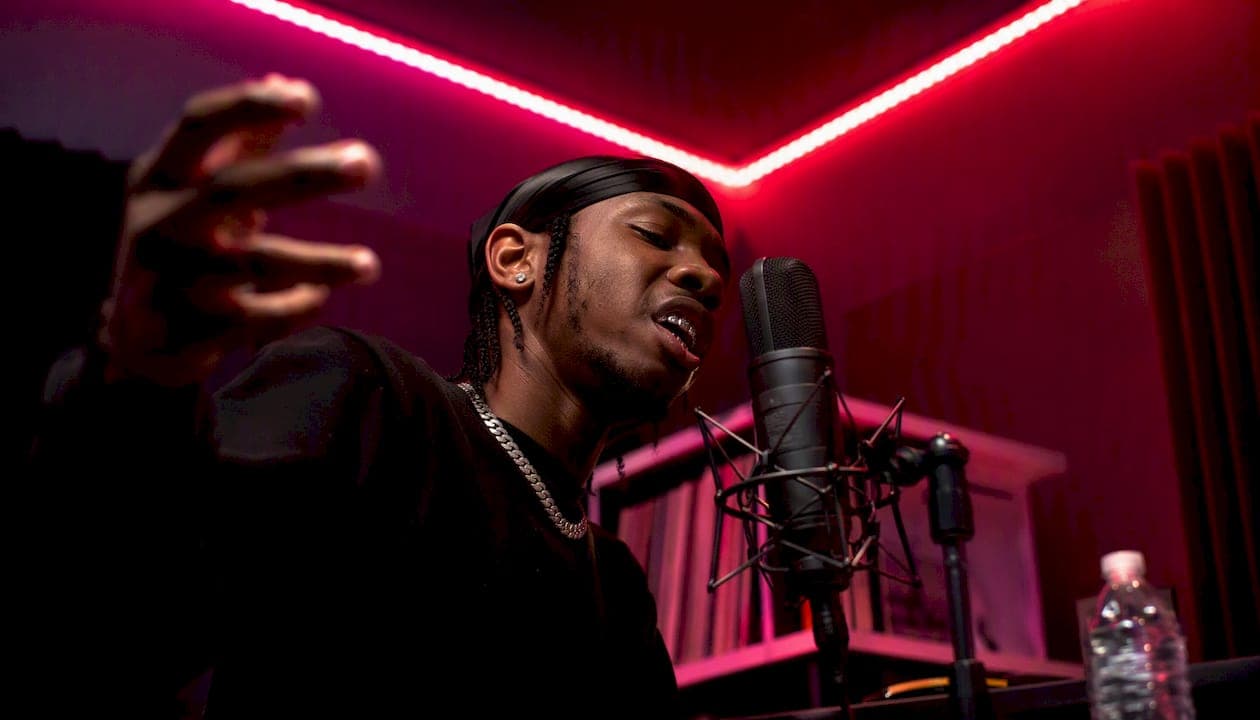
Rap cadence is the rhythmic pattern of how your syllables land against the beat, specifically where they fall, how long they hold, and how they accent. According to the Rap Dictionary, cadence is the rhythmic flow of lyrics and the rise and fall of vocals. Right now, pick any four-bar loop and speak one sentence over it, then shift where the stressed syllables land. That shift is cadence at work. Musicologist Kyle Adams frames it as a technical toolkit, jazz pianist Robert Glasper calls frequent cadence shifts a hallmark of elite rappers, and Kendrick Lamar's mid-verse cadence changes are among the clearest live demonstrations of the concept.
Key Takeaways
Cadence is the single most controllable element of your rap delivery, and deliberate practice with subdivisions, syncopation, and cadence-switching builds the rhythmic identity that makes an artist recognizable.
| Point | Details |
|---|---|
| Cadence defined | The rhythmic pattern of syllable placement, stress, and timing against the beat grid. |
| Cadence vs. flow | Flow is the full rhythmic system; cadence is one specific dimension within it. |
| Two technique categories | Metrical techniques govern where syllables fall; articulative techniques govern how they sound. |
| Core practice drill | Record the same verse with two different cadences and A/B compare the playback. |
| Cadence and identity | Frequent cadence shifts, as Robert Glasper notes, are a hallmark of technical mastery. |
Table of Contents
- What does rap cadence meaning actually cover?
- The musical building blocks that create cadence
- How cadence shapes tension, phrasing, and musical identity
- Step-by-step drills to develop and switch cadence
- How to study and transcribe cadences from recordings
- Frequent beginner errors when practicing cadence
- Annotated listening examples tied to named artists
- How rap cadence evolved and why it matters culturally
- How cadence deepens lyrical impact and storytelling
- Cadence is the part of your voice you can actually control
- Sources
What does rap cadence meaning actually cover?
Cadence, flow, and delivery get used interchangeably, but they describe related yet distinct aspects of rap performance. Mixing them up can make it harder to pinpoint what feels off when analyzing a verse.
Per Decoded, the distinctions break down like this:
- Cadence vs. flow: Flow is the broader system, how your lyrics fit rhythmically with the beat across a full verse. Cadence is one specific dimension inside flow: the pattern of stressed and unstressed syllables and where they land on the grid. You can have a consistent flow but switch cadence mid-verse.
- Cadence vs. delivery: Delivery covers everything about how you perform, volume, emotion, breath, stage presence. Cadence is narrower. It is purely rhythmic placement and syllable stress. Two rappers can deliver the same line with completely different emotional energy but identical cadence.
- Cadence vs. rhythm/beat: The beat provides the rhythmic grid. Cadence is what you do against that grid, whether you land on the downbeat, push ahead of it, or sit behind it.
A quick example: rapping "I got the flow" with emphasis on "got" versus emphasizing "flow" with timing shifted slightly behind beat three demonstrates how the same words and beat can give different cadences.
The musical building blocks that create cadence
Kyle Adams's research organizes cadence techniques into two categories: metrical and articulative. Both are levers you can practice independently.
Metrical techniques govern where syllables fall on the beat grid:
- Placement of rhyming syllables (on the downbeat vs. the "and" of a beat)
- Placement of accented syllables relative to the measure
- Syllables per beat (density: sparse vs. packed)
- Correspondence between syntax and measure boundaries (does a phrase end where the bar ends, or does it spill over?)
Articulative techniques govern how syllables sound when they land:
- Legato vs. staccato (smooth connected syllables vs. clipped, separated ones)
- Consonant articulation (hard stops on "t," "k," "p" vs. softer fricatives)
- Pitch and timbre shifts mid-line
- Micro-timing (landing fractionally early or late for feel)
3 things to listen for in any verse: (1) Where does the rhyme syllable land relative to beat one? (2) Are the syllables connected or clipped? (3) Does the phrase end at the bar line or spill past it?
Straight eighth-note cadences feel even and driving. Triplet subdivisions give a rolling, three-against-two feel. Syncopated cadences push syllables off the beat entirely, creating tension that resolves when the rhyme finally lands on a strong beat.
How cadence shapes tension, phrasing, and musical identity
Mastering cadence is critical for artistic identity. When you change cadence mid-verse, you treat your vocal line the way a horn player treats a melody: as something that can accelerate, breathe, and surprise. Robert Glasper, whose work bridges jazz and hip-hop, has noted that elite technical rappers frequently shift cadence and voice, using those shifts the way instrumentalists use dynamics.
Changing cadence mid-verse lets a rapper control tension and release the same way a musician controls dynamics. The voice becomes an instrument, not just a delivery mechanism.
Kendrick Lamar's verse on "Backseat Freestyle" demonstrates this directly. He opens with a dense, on-beat cadence, then loosens into a syncopated pattern mid-verse before snapping back. The shift creates a wave of tension and release without changing a single word. Cadence creates groove, identity, and memorability in exactly this way. It is also what makes an artist sound like themselves. Rakim's cadence is so distinctive that you recognize it in two bars. That is not accident; it is deliberate rhythmic identity built through repetition and refinement.
How cadence shapes fan loyalty and connection is underappreciated. Listeners bond to the rhythmic feel of an artist before they consciously process the lyrics.
Step-by-step drills to develop and switch cadence
Practical drills include recording a verse in multiple rhythms and using a metronome to practice subdivisions. Here is a four-week progression:
- Week 1: Metronome and subdivision mapping. Speak sentences over four-bar loops landing stressed syllables on various beat subdivisions to understand feel.
- Week 2: Triplet drills. Use triplet subdivisions to vary phrasing and rhythm.
- Week 3: Syncopation practice. Experiment with rhyme placement off the strong beats to develop comfort with tension.
- Week 4: Cadence-switching exercise. Practice intentional shifts between dense and sparse cadences within verses.
Pro Tip: Record every drill session and A/B compare two takes of the same verse with different cadences. Your ear will catch what your brain misses in real time.
How to study and transcribe cadences from recordings
A focused listening workflow turns passive listening into active skill-building.
- Slow the track down. Use a DAW or an app like Transcribe! to reduce playback to 70–80% speed without changing pitch. Syllables that blur at full speed become audible.
- Isolate a 4-bar loop. Pick the most interesting four bars in a verse and loop them. Do not move on until you can map every syllable to a beat position.
- Mark syncopation. Write out the beat grid (1, and, 2, and, 3, and, 4, and) and place each syllable above its position. Syllables that fall between positions are syncopated.
- Identify cadence switches. Note the bar where the rhythmic pattern changes. Ask: did the density increase or decrease? Did the rhyme syllable shift position?
- Mark breath points. Breath placement is part of cadence. Note where the rapper breathes and whether it creates a pause that functions as a rhythmic rest.
Tracks worth studying: Rakim's "Paid in Full" for foundational on-beat density; Slick Rick's "Children's Story" for articulative relaxation and storytelling cadence; Kendrick Lamar's "m.A.A.d city" for mid-verse cadence switches; Eminem's "Rap God" for extreme syllable density against a steady grid.
Frequent beginner errors when practicing cadence
- Rushing ahead of the beat. Root cause: anxiety and lack of metronome work. Fix: slow the BPM to 60 and speak the verse until every syllable lands where you intend, then gradually increase tempo.
- Ignoring breath points. Root cause: treating cadence as purely rhythmic and forgetting that breath is a rest. Fix: mark breath points in your written lyrics before you record.
- Copying cadence wholesale. Root cause: learning by imitation without adaptation. Fix: transcribe an artist's cadence, then rewrite your own lyrics to fit that rhythmic skeleton. You borrow the pattern, not the phrasing.
- Rigid phrasing. Root cause: always ending phrases at the bar line. Fix: write one verse where every phrase spills one or two syllables past the bar line. It forces you to feel the difference between metrical and syncopated phrasing.
Annotated listening examples tied to named artists
- Rakim, "Paid in Full" (1987). Rakim shifted rap cadence by introducing internal rhymes and multi-syllabic patterns over a steady on-beat grid. Listen for how rhyme syllables land on beats two and four with clockwork precision. Mimic exercise: write four bars where every rhyme lands on beat four, no exceptions.
- Slick Rick, "Children's Story" (1988). Slick Rick's cadence is articulative mastery: legato, conversational, with hard consonant stops used for comic or dramatic emphasis. Listen for the staccato "t" and "k" sounds at phrase endings. Mimic exercise: record a four-bar story verse and clip every final consonant hard.
- Melle Mel, "The Message" (1982). Melle Mel's cadence is dense and declarative, syllables packed tightly against the beat with minimal syncopation. It established the template that later artists would complicate. Listen for how the stress pattern mirrors spoken-word cadence more than musical cadence.
- Kendrick Lamar, "m.A.A.d city" (2012). Mid-verse, Kendrick shifts from a tight, on-beat cadence to a loose, behind-the-beat drawl. The shift signals a narrative change. Mimic exercise: record eight bars and deliberately change your cadence at bar five.
- Eminem, "Rap God" (2013). Eminem's cadence here is a study in density: syllables packed three and four per beat in the fast section. The contrast with the slower sections makes both feel more extreme. Listen for how the rhyme scheme stays consistent even as the syllable rate triples.
How rap cadence evolved and why it matters culturally
Rap cadence did not arrive fully formed. Early recordings from the late 1970s, including Melle Mel's work with Grandmaster Flash, used cadences close to spoken-word patterns: syllables landing on strong beats, phrases ending at bar lines, minimal syncopation. The historical record shows that Rakim's arrival in the mid-1980s changed the game. He introduced internal rhymes and multi-syllabic patterns that pushed cadence away from speech and toward instrumental phrasing.
By the 1990s, cadence had become a primary marker of regional identity. East Coast rappers favored dense, on-beat patterns. Southern rap developed slower, more syncopated cadences that matched the tempo of chopped-and-screwed production. West Coast artists layered melodic cadence over funk-influenced beats. Each regional style was, at its core, a different answer to the same question: where do the syllables go?
Cadence carries cultural weight because it encodes where an artist comes from and who they are speaking to. When a rapper switches cadence mid-verse, they are not just showing technical range. They are signaling fluency across multiple traditions.
How cadence deepens lyrical impact and storytelling
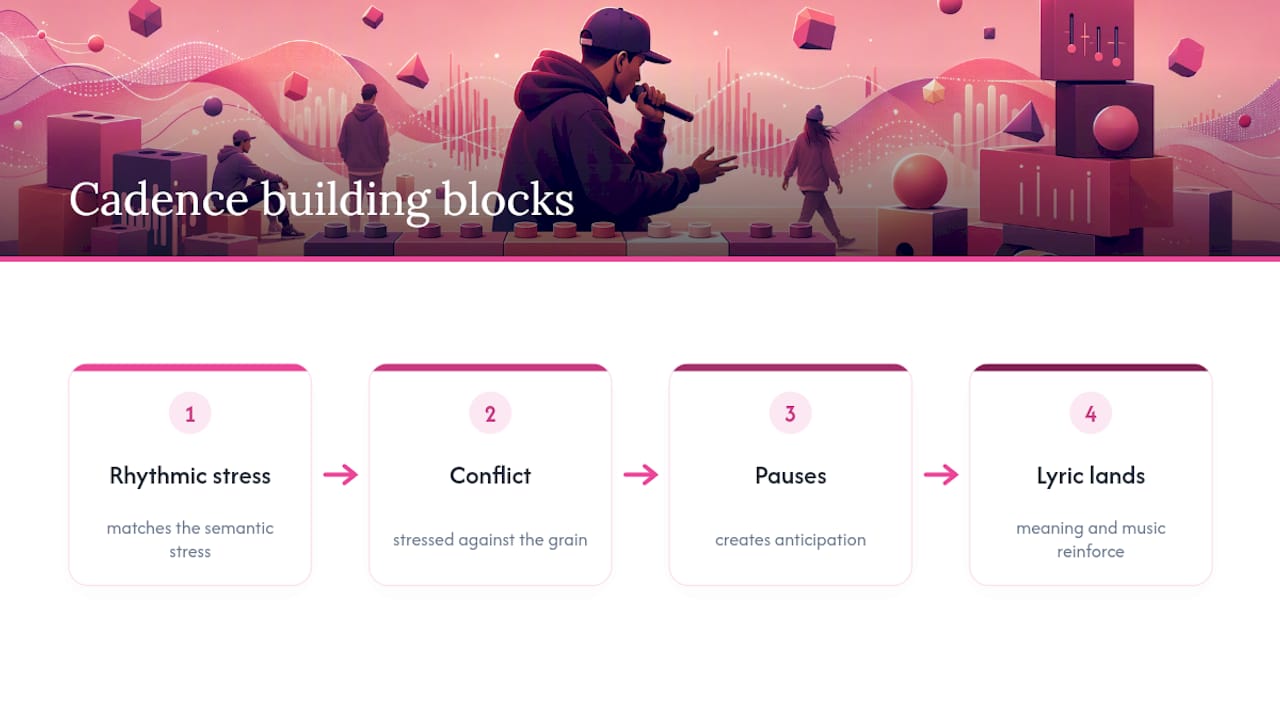
Cadence is the difference between a lyric that lands and one that slides past. When the rhythmic stress of a line matches the semantic stress of the words, meaning and music reinforce each other. When they conflict deliberately, the tension draws attention to the word being stressed against the grain.
Slick Rick's storytelling cadence works because the relaxed, conversational rhythm makes the listener feel like they are being told a story in real time. The cadence creates intimacy. Kendrick Lamar's cadence shifts serve a different narrative function: they signal a change in perspective or emotional register, the way a film score shifts key when the scene changes.
Pauses are part of this. A rest in the cadence, a beat where no syllable lands, creates anticipation. The rhyme that follows a pause hits harder because the ear has been waiting. This is tension and release at the syllable level, and it is one of the most direct ways cadence shapes how a listener experiences a story.
Cadence is the part of your voice you can actually control
Most aspiring rappers spend their practice time on lyrics and almost none on cadence. That is backwards. Lyrics are what you say. Cadence is how the listener hears it.
When I started working on my own sound, the shift that opened everything up was not writing better bars. It was learning to treat my vocal rhythm as a separate instrument from the words themselves. Mumbling nonsense syllables over a beat to find a natural cadence pattern, then fitting words to that rhythm, produced verses that felt inevitable rather than forced. The words landed because the rhythm was already there.
The next step is simple: pick one drill from the practice section above, set a four-bar loop, and record two takes with different cadences. Listen back. You will hear the difference immediately, and that difference is the beginning of a signature sound.
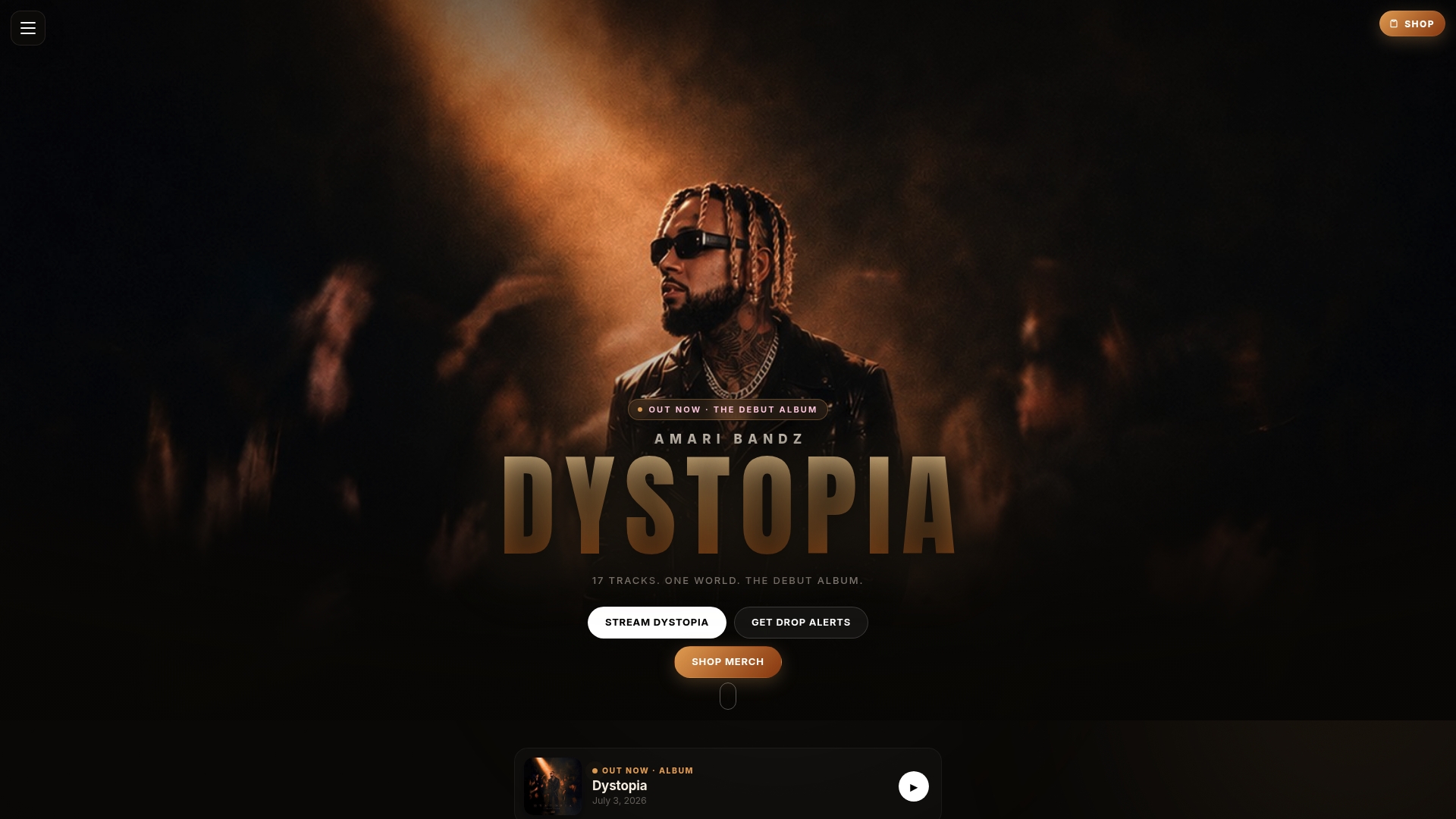
Hear how cadence works in practice on Amari Bandz's debut album DYSTOPIA, where melodic elements and traditional rap cadence meet in tracks like "Japan" and "Currency."
Sources
- Kendrick Lamar: Cadence and the voice as instrument (DJBooth feature)
- Kyle Adams — On flow and the metrical/articulative techniques in rap (MTO)
- Cadence definition (Rap Dictionary)
- What is cadence in rap and why does it matter? (Stephen Allen Music Group)
- Flow & cadence decoded (Decoded)