
For most Amari Bandz indoor posters, coated stock with medium weight is the right call. It hangs flat, holds color well, and ships without drama. If you're ordering a limited-edition print or something going into a frame, step up to heavier coated stock. For rolled mail orders, lighter coated stock keeps shipping costs manageable.
Three quick picks:
- coated satin stock — the default for wall-hung fan posters; prevents sagging and curling when hung
- a lighter weight range coated — rollable, mail-friendly, good for standard merch runs shipped across the U.S.
- a heavier weight range gloss or satin — premium posters and freestanding displays that need a card-like feel and durability
Before any bulk order, request a physical printed sample. Color, stiffness, and finish all read differently in hand than on a spec sheet.
Table of Contents
- Which poster paper weight fits your actual use case?
- How weight, finish, and caliper change what you actually see and feel
- Shipping and packaging trade-offs by paper weight
- How GSM translates to U.S. lb paper weights
- Concrete stock picks for Amari Bandz posters
- What to check before placing a bulk poster order
- Key Takeaways
- Why the paper spec is actually a fan decision, not just a production one
- Get your official Amari Bandz poster today
- Useful sources
Which poster paper weight fits your actual use case?
How you plan to display or ship the poster should drive the stock choice more than anything else.
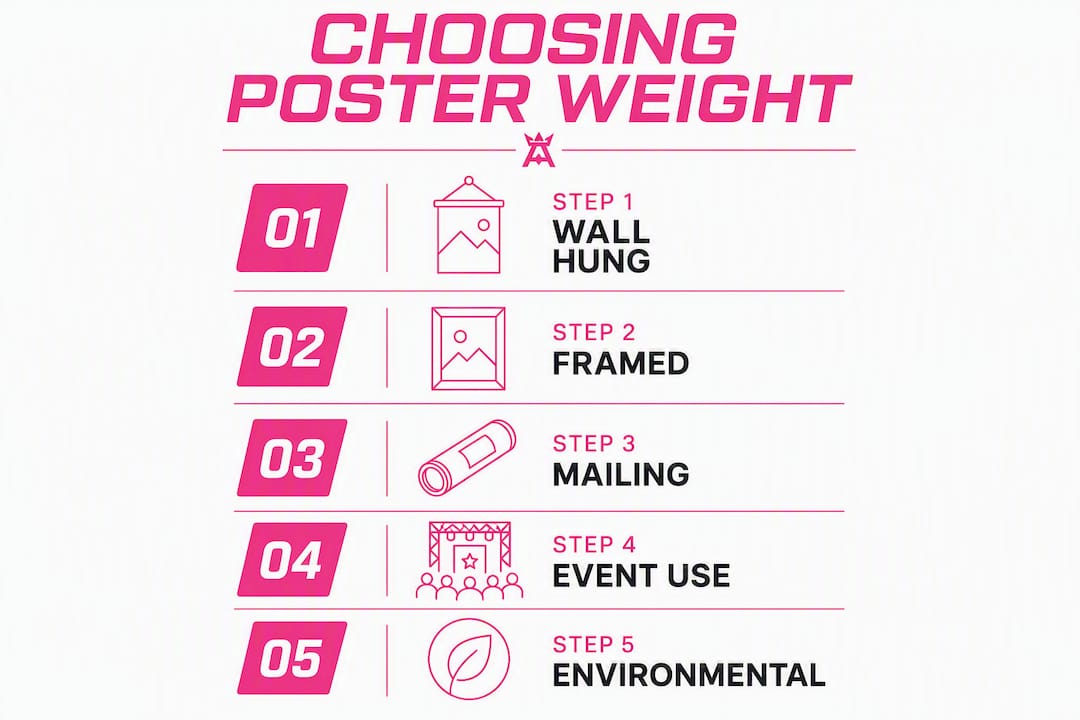
Wall-hung bedroom poster — medium-weight coated satin or gloss covers this perfectly. The coating keeps colors punchy, and the weight is enough to lie flat against the wall without curling at the corners. For larger sizes like A1 or 24×36 inches, treat a practical minimum weight; anything lighter will sag.
Framed or limited-edition piece — go heavier. heavier coated stock gives the poster a substantial feel that signals quality the moment a fan pulls it out of the packaging. It also survives repeated handling without creasing.
Rolled and mailed to fans — lighter coated stock is practical. It rolls cleanly into a wide-diameter tube, costs less per unit to ship, and still looks sharp on the wall. Go lighter than 150gsm and you risk creasing; go heavier and shipping costs climb fast.
Event or table display — anything freestanding needs heavier coated stock at minimum, or it will flop. For outdoor event use, very heavy coated stock with UV-resistant coating is standard.
| Use Case | Recommended GSM | Why It Works |
|---|---|---|
| Wall-hung bedroom poster | 170gsm coated satin | Hangs flat, cost-effective, good color |
| Framed / limited edition | 200–250gsm gloss or satin | Rigid, premium feel, survives handling |
| Rolled mail order | 150gsm coated | Rolls cleanly, lower shipping cost |
| Event / freestanding display | 200–250gsm coated | Self-supporting, resists edge damage |
| Outdoor signage | 250–300gsm coated plus UV finish | Weather-resistant, durable |
On environmental options: recycled stocks typically land in the 150–200gsm range and work well for standard indoor posters. They tend to show slightly less color saturation than premium coated papers, so factor that in if Amari Bandz's neon-heavy artwork is the centerpiece.
How weight, finish, and caliper change what you actually see and feel
Weight controls stiffness and curl resistance. Finish controls glare and color depth. Both matter, and they work together.

A medium-weight satin finish is the most practical combination for Amari Bandz visuals: enough rigidity to hang flat, and a surface that tones down glare without killing the vibrancy of neon pinks and reds. Gloss at heavier coated stock pushes color saturation higher, which suits limited-edition art prints where photographic depth is the point. Matte works well for text-heavy designs or anything displayed under bright overhead lighting where glare would be a problem.
Caliper (physical thickness) is a separate spec from GSM, and the two don't always move in lockstep. A bulky, lower-density sheet can feel thicker than a denser sheet of the same weight. For poster work, both specs matter: caliper affects how the poster feeds through a press and how stiff it feels in hand. When stiffness is critical, ask your printer for the caliper measurement alongside the GSM, or just request a sample.
Pro Tip: Pair a coated stock with medium weight with a high-quality satin or gloss coating rather than jumping straight to 200gsm. You get most of the perceived quality at a lower per-unit cost, which matters when you're running a merch drop of several hundred prints.
Shipping and packaging trade-offs by paper weight
Heavier stock costs more to ship and needs sturdier packaging. That's the core trade-off, and it shapes every merch decision.
- Rolled shipping (a medium weight range): Use a wide-diameter tube (at least 3 inches across) with a waterproof sleeve inside. This keeps per-unit shipping costs lower and works well for standard fan orders across the U.S.
- Flat shipping (a heavier weight range): Requires rigid cardboard backing, corner protectors, and a poly bag or waterproof wrap. Damage risk drops significantly, but the box adds weight and dimensional size, both of which raise carrier costs.
- Damage risk: Lighter rollable stock can crease if a tube gets crushed; heavier flat-packed prints can suffer corner damage if the backing board isn't stiff enough.
Pro Tip: For limited-edition signed prints, always ship flat with corner protection and a rigid backing board. For standard merch runs, rollable mid-weight stock keeps per-unit shipping predictable and fan-friendly.
The balance between spec and practicality is real: lighter poster stocks are easier to handle in bulk and more cost-effective for short-term campaigns, while heavier sheets resist wrinkling and edge damage more effectively. Reserve the heavy cover stock for limited runs or collectors' editions where the premium feel justifies the extra shipping cost.
How GSM translates to U.S. lb paper weights
U.S. printers use a "pound" (lb) system that confuses almost everyone, because the number changes depending on the paper family. Here's the short version:
| GSM Range | Approx. U.S. Equivalent | Caveat |
|---|---|---|
| 150gsm | ~60 lb text / ~40 lb cover | Varies by paper family |
| 170gsm | ~70 lb text / ~45 lb cover | Text and cover scales differ |
| 200gsm | ~90 lb text / ~54 lb cover | Confirm with your printer |
| 250–300gsm | ~100–110 lb cover | Cover stock scale most accurate here |
The key caveat: U.S. lb classifications use different base sheet sizes for text vs. cover stocks, so the same GSM maps to a different lb number depending on which family you're in. A 170gsm sheet might be called 70 lb text by one printer and 45 lb cover by another. Always confirm with your specific printer and request a sample before committing.
- Conversions are approximate and vary by paper family
- Text weight (lb) and cover weight (lb) use different base measurements
- When in doubt, specify GSM directly — it's unambiguous
Concrete stock picks for Amari Bandz posters
Three tiers, matched to how the merch actually gets used:
- Default merch run — 170gsm coated satin stock: Covers most fan poster orders. Hangs flat, ships rolled, and the satin finish handles Amari Bandz's neon color palette without washing out under room lighting. 170gsm is the standard for A0/A1 displays and works equally well at smaller sizes.
- Mail-friendly standard — 150gsm coated stock: For high-volume drops where keeping shipping costs accessible matters. Still looks sharp on the wall; just avoid sizes larger than 18×24 inches at this weight or you'll see some curl.
- Premium limited edition — 200–250gsm gloss or satin, shipped flat: For signed prints, collectors' editions, or anything bundled with a download card as a phygital merch package. Gloss pushes color saturation for the neon-heavy artwork; satin gives a slightly more refined look under gallery or bedroom lighting.
For sizes above larger sizes, large-format inkjet photo papers replace standard press stocks. At that scale, Premium Matte suits text-heavy or gallery-lit designs; Satin Gloss suits image-driven artwork where color intensity is the whole point.
Always order a printed sample before a full run. A proof catches color shifts, finish surprises, and stiffness issues that no spec sheet will warn you about.
What to check before placing a bulk poster order
- Order a printed sample first — check finish, color accuracy, and stiffness in hand before approving anything.
- Set up your file in CMYK — RGB files convert unpredictably at the press; neon colors especially can shift.
- Include bleed and safe zones — standard is standard bleed on all sides of bleed on all sides; keep text and key art safe margin from the trim edge from the trim edge.
- Confirm the color profile with your printer — ask which ICC profile they use and embed it in your file.
- Get a signed proof — a digital soft proof is a starting point; a physical press proof is the real sign-off.
- Run a shipping test — mail one sample in the intended packaging (tube or flat) to a U.S. address and inspect it on arrival.
- Confirm GSM and caliper — ask for both specs, not just GSM, especially if stiffness matters for the format.
- Check environmental options — if recycled stock is a priority, confirm it's available in your target GSM range and request a color sample, since recycled stocks can run slightly less saturated.
- Factor per-unit cost by weight — heavier stock and flat shipping add up fast on large runs; run the numbers before finalizing the spec.
Key Takeaways
For most Amari Bandz fan posters, coated satin stock is the right default: it hangs flat, ships well, and holds color without requiring premium flat-pack shipping.
| Point | Details |
|---|---|
| Default stock | 170gsm coated satin stock handles most indoor fan posters and ships rolled without issue. |
| Premium option | 200–250gsm gloss or satin for limited editions; ship flat with corner protection. |
| Mail-friendly option | 150gsm coated stock rolls cleanly and keeps U.S. shipping costs accessible. |
| Always sample first | Order a physical proof before any bulk run to check color, finish, and stiffness. |
| Amaribandz merch | Official posters are available at the Amaribandz merch store in sizes and finishes matched to these specs. |
Why the paper spec is actually a fan decision, not just a production one
Here's the angle most merch guides miss: the paper weight isn't just a printer's problem. It's a direct signal to the fan about what the artist thinks of them.
A thin, curling poster says "we printed the cheapest thing that would ship." A 170gsm satin print says "we thought about how this looks on your wall." A 250gsm flat-packed limited edition says "this is a collectible, treat it like one." Fans read that signal instantly, even if they couldn't name a GSM if you asked them.
The conventional wisdom is to go as heavy as budget allows. That's wrong for a merch operation that actually ships to fans. A 300gsm poster in a flat box can cost two or three times as much to ship as a 160gsm rolled print, and for a fan paying out of pocket, that shipping line item is what kills the purchase. The smarter move is to tier it: mid-weight rollable stock for the standard drop, heavy flat-packed stock reserved for the limited run where the fan already expects to pay more. That way the premium feel lands where it matters, and the everyday merch stays accessible.
The other thing people underestimate is finish. A mid-weight satin at 170gsm will outperform a heavier uncoated sheet for perceived quality every time, because the coating is what makes color pop and the surface feel intentional. Weight gets you stiffness. Coating gets you the look. Both matter, but if you have to choose where to spend, spend on the coating first.
Get your official Amari Bandz poster today
The Amaribandz merch store carries current poster offerings in the sizes and finishes covered here, from standard wall prints to limited-edition flat-packed pieces. Every poster is produced to the specs that match the artwork, so the neon palette hits the way it's supposed to.

For group orders or bulk shipping rates, reach out to the merch team directly through the site. If you're unsure which size or finish to order, the merch page lists current stock with format details. Check availability before committing to a bulk run, and if you want to see the finish in person before ordering, ask about sample availability. The Amaribandz home page also links to the latest releases and exclusive fan updates, so you can pair a new poster with the drop it came from.
Useful sources
- Poster Sizes & Paper: A Printing Guide — Printscene — industry-standard GSM ranges and the 170gsm practical minimum for indoor posters
- The Practical Paper GSM Guide — Paper Direct — a heavier weight range recommendations for premium and freestanding displays
- Choosing the Right Paper for Large-format Posters — Paper Direct — GSM vs. caliper, spec-to-cost trade-offs, and finish guidance
- Poster Paper Guide: Weights, Finishes & Sizes Explained — Printkeg — press stock vs. inkjet photo paper by size, and lb weight breakdowns
- Paper Weight & GSM Guide — PaperLust Printshop — practical weight ranges from lightweight flyers through display-grade stocks
- What is Paper Weight (GSM)? — Poster Prints — finish guidance and why stocks below 150gsm fall short for lasting poster use
- Which GSM is Best for Printing? — Printigly — indoor vs. outdoor GSM ranges and foam-mounted display specs
Every source above gives general guidance based on print industry standards. Your specific printer's press, ink system, and available stocks will affect the final result, which is exactly why requesting a physical sample before any bulk run remains the single most reliable step in the process.