
What are the best Linktree alternatives for musicians right now?
The short answer: Feature.fm, Linkfire, and Odesli lead for serious music promotion, while Beacons and Bandzoogle win for artists who want an all-in-one setup. Linktree itself has become a harder sell since raising prices across all tiers in November 2025, with its Monetize plan jumping from $9 to $15/month and its Ultimate plan climbing from $24 to $35/month. For musicians specifically, the platform was never purpose-built for music anyway. It shows fans a list of streaming platforms and asks them to pick one, which creates real drop-off before anyone hits play.
The tools below are built differently. They detect a fan's device or location and route them automatically, embed players directly on the page, and collect email addresses without locking that feature behind a premium tier.
| Tool | Best For | Music-Specific Features | Pricing | Ease of Use | Email Collection | Customization | Analytics |
|---|---|---|---|---|---|---|---|
| Feature.fm | Campaign-driven promotion | Pre-saves, smart links, stream tracking | Paid tiers | Moderate | Yes | High | Advanced |
| Linkfire | Multi-project artists | Geo-detection, multi-account, smart routing | Paid tiers | Moderate | Yes | High | Industry-leading |
| Odesli | Auto-routing smart links | Platform auto-detection, streaming aggregation | Free + paid | Easy | Limited | Low | Basic |
| Beacons | Easy setup, music templates | Music embeds, social integrations | Free + paid | Very easy | Yes | Medium | Good |
| Bandzoogle | Full website + links | E-commerce, direct sales, streaming links | Paid tiers | Moderate | Yes | Very high | Good |
| ToneDen | Social ad campaigns | Smart links, fan targeting, ad tools | Free + paid | Moderate | Yes | Medium | Strong |
| Hypeddit | Fan growth contests | Fan rewards, giveaways, link-in-bio | Free + paid | Easy | Yes | Medium | Basic |
| ForeverFan | Fan subscriptions | Fan club, subscription tools, bio linking | Paid tiers | Moderate | Yes | Medium | Good |
| taap.bio | Indie artists on a budget | Spotify and Apple Music integrations | Free + paid | Very easy | Limited | Medium | Basic |
| Amplify.link | Customizable bio links | Embedded players, streaming integrations | Free + paid | Easy | Yes | High | Good |
| Sonikit | Pre-release campaigns | Pre-save tools, campaign management | Paid tiers | Moderate | Yes | Medium | Good |
| Komi | Talent and celebrity branding | Branded pages, social integration | Paid tiers | Easy | Yes | High | Good |
| Campsite.bio | Flexible simple pages | Clean design, customization options | Free + paid | Very easy | Yes | Medium | Basic |
| Campsite | No-frills bio pages | Mobile optimized, clean UI | Free + paid | Very easy | Limited | Low | Basic |
| Solo.to | Fast deployment | Clean UI, minimal setup | Free | Very easy | Limited | Low | Basic |
| Koji | Interactive monetization | Fan tips, interactive widgets | Free + fees | Easy | Yes | Medium | Basic |
| Linktree | General link collection | Limited music tools, template library | Free + paid | Very easy | Paid tier only | Medium | Paid tier only |
The TL;DR: If you run pre-save campaigns and care about stream attribution, Feature.fm or Sonikit. If you manage multiple releases or artist accounts, Linkfire. If you want a full website with built-in merch sales, Bandzoogle. If you just need something fast and clean, Beacons or taap.bio. Linktree works, but generic tools get flagged as spam by Instagram and TikTok, and its music-specific feature set is thin compared to every purpose-built option on this list.
In-depth comparison of Linktree alternatives for music promotion
The gap between a generic bio link tool and a music-specific one shows up fast. Generic platforms hand fans a list of buttons and walk away. Music-focused platforms detect where the fan is, what device they're on, and send them straight to the right streaming service without an extra click.
Feature.fm and Sonikit: built for campaigns
Feature.fm is the go-to for artists running structured release campaigns. Its pre-save support spans Spotify, Apple Music, Deezer, and Amazon Music simultaneously, and its analytics track actual conversion events rather than just link clicks. If you're pitching to playlists or running a release week push, the campaign dashboard gives you the data to know what's working mid-campaign, not after.

Sonikit sits in a similar lane. It specializes in pre-release marketing, with pre-save tools and campaign management built into the core product rather than bolted on as add-ons. For artists focused on maximizing first-week streaming numbers, both platforms offer more than any general-purpose bio link tool.
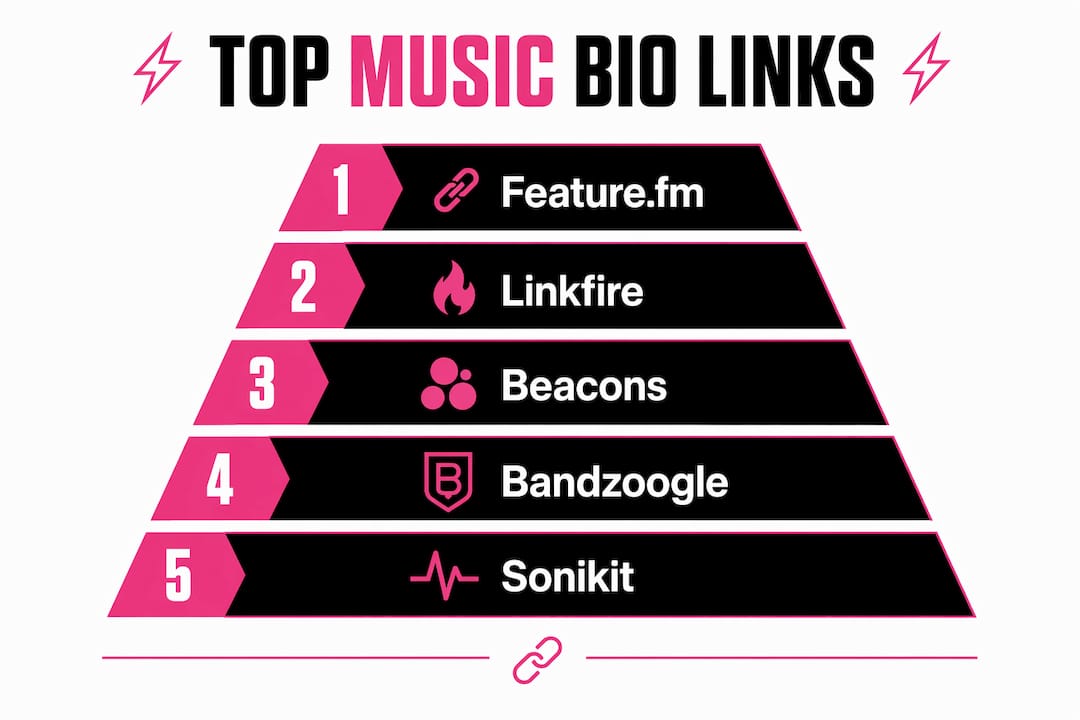
Linkfire: the industry standard for catalog management
Linkfire is what major labels and distributors use when they need to manage dozens of artist accounts and hundreds of releases without losing their minds. Its geo-detection routes fans to the right regional store or streaming service automatically. Multi-account support means a manager can run five artists from one dashboard. The analytics go deep enough that ad buyers can see which creatives drive actual streams versus passive clicks. For an independent artist with a growing catalog, Linkfire's multi-account features make it worth the learning curve.
Beacons and taap.bio: fast and music-friendly
Beacons has become the default recommendation for artists who want something set up in under an hour. The music-friendly templates look good without requiring design skills, and the social media integrations cover Instagram, TikTok, and YouTube without friction. Email collection is included on the free tier, which puts it ahead of Linktree on that dimension alone.

taap.bio targets indie artists who want strong Spotify and Apple Music integrations at a low price point. The interface is clean, the setup is fast, and it doesn't overwhelm you with features you won't use. For an artist just starting to build their online presence, it's a practical first stop.
Bandzoogle: when you want more than a bio link
Bandzoogle is a different category of tool. It builds you a full artist website with e-commerce, direct music sales, and streaming links all under one roof. If you're selling physical merch, digital downloads, and concert tickets alongside your streaming links, Bandzoogle handles all of it without requiring third-party integrations. The trade-off is setup time. It takes longer than a bio link tool, but what you get is a real owned web presence rather than a page that lives on someone else's domain.
ToneDen and Hypeddit: fan growth with a marketing angle
ToneDen combines smart links with social media advertising tools, making it useful for artists who run paid campaigns on Facebook or Instagram alongside their organic content. The fan targeting features let you build retargeting audiences directly from your bio link traffic.
Hypeddit takes a different approach to fan growth: contests and giveaways. Fans unlock a download or exclusive content by following your social accounts or pre-saving a release. It's a proven tactic for building follower counts quickly, and Hypeddit wraps it into the bio link experience cleanly.
ForeverFan, Koji, and Komi: monetization and fan clubs
ForeverFan is purpose-built for artists who want to run a fan subscription model. The bio link is integrated, but the real product is the fan club infrastructure: tiered memberships, exclusive content delivery, and subscriber management. Koji offers interactive widgets and fan tip functionality, with monetization built into individual link blocks rather than a subscription model. Komi leans toward branded pages for talent and celebrity-level artists, with polished design options and strong social integration.
Amplify.link, Campsite, Campsite.bio, Solo.to, and Odesli
Amplify.link gives you embedded music players and solid streaming integrations with more design freedom than most mid-tier tools. Campsite and Campsite.bio are clean, simple, and mobile-optimized. Solo.to is the fastest setup on the list with a minimal interface. Odesli is the specialist: it aggregates streaming platforms and auto-routes fans to their preferred service, making it the strongest pure smart-link option for artists who just need that one function done well.
Pro Tip: Before committing to any paid plan, test the free tier with a real release link and share it in your Instagram bio for one week. Check which platform your fans actually click. That data tells you more about your audience than any feature comparison.
How to choose the right link in bio tool for musicians
The wrong tool costs you fans before they ever hear your music. Here's how to think through the decision.
What actually matters when you're choosing
Music-specific features come first. A tool that embeds a player directly on the page keeps fans engaged longer than one that sends them to Spotify and hopes they come back. Pre-save support across multiple platforms matters if you release music regularly. Geo-detection matters if you have international listeners.
Pricing flexibility matters more than the free tier. Most tools offer a free plan, but the features that actually move the needle, like email capture, pixel tracking, and conversion analytics, sit behind paid tiers. Compare what you get at the $9–$15/month range across platforms, because that's where the real differences show up.
Analytics depth determines whether you can improve. Click counts are table stakes. What you want is stream attribution: did the fan who clicked your Spotify button actually listen? Feature.fm and Linkfire track this. Most generic tools don't.
Email and fan data ownership is non-negotiable long-term. Social platforms change their algorithms. Streaming services change their payout rates. Your email list is the one asset you actually own. Choose a tool that collects emails natively and lets you export that list whenever you want.
Questions every musician should ask before signing up
- Does this tool embed a music player, or does it just link out to streaming platforms?
- Can I collect fan emails on the free plan, or is that locked behind a paid tier?
- Does it support pre-saves on Spotify, Apple Music, and Deezer, or just one platform?
- Can I use my own custom domain, or will my links live on someone else's URL?
- Does it track actual stream conversions, or just link clicks?
- Will this link get flagged as spam on Instagram or TikTok?
Common mistakes musicians make with bio link tools
The biggest mistake is treating the bio link as a menu. Listing every streaming platform, your merch store, your YouTube channel, your tour dates, and your press kit on one page overwhelms fans and reduces clicks across the board. Pick a primary call to action based on what matters most right now: a new release, a pre-save, or a merch drop.
The second mistake is ignoring mobile optimization. Most fans click your bio link from a phone. If the page loads slowly or the buttons are hard to tap, you lose them in the first three seconds. Every tool on this list is mobile-optimized, but some are better than others. Campsite, taap.bio, and Beacons are consistently strong on mobile load speed.
The third mistake is skipping the custom domain. When your bio link lives on linktr.ee or beacons.ai, you're building traffic on someone else's domain. Owning your fan data starts with owning your URL. Several tools on this list include a custom domain on all plans, including free ones.
Pro Tip: Route your Instagram, TikTok, and YouTube bio links to the same page, but use separate UTM parameters for each platform. You'll see exactly which social channel drives the most fan traffic, and you can double down on what's actually working.
For a broader look at how independent artists are building fan relationships beyond the bio link, the fan engagement platforms guide covers the full stack of tools worth knowing in 2026.
Why musicians should own their link in bio and how to use it effectively
Your bio link is the one place online where you control the entire experience. Every other platform, Spotify, Instagram, TikTok, YouTube, decides how your content is presented, what gets recommended next, and whether your fans see your posts at all. Your bio link page is yours.
Redirect friction is costing you listeners
When a fan clicks your bio link and lands on a list of streaming platforms, they have to make a decision. That extra step causes real drop-off. Music-specific tools with smart routing eliminate that friction by detecting the fan's device and sending them directly to their preferred platform. The difference between a fan who lands on your Spotify page and one who abandons the process at a platform selection screen is a stream, a save, and potentially a follower.
Embedding music keeps fans on your page longer
A bio link page that plays your music directly, without redirecting to Spotify first, gives fans a reason to stay. They hear the track, read your bio, see your latest merch drop, and sign up for your email list, all in one visit. That's the difference between a link page and an artist home. Embedding players and capturing email on the same page is how independent artists build fanbases that exist outside of any single platform's algorithm.
Fan data ownership protects your career
When a streaming platform changes its algorithm or a social network limits your organic reach, artists who own their fan email lists keep their audience. Artists who don't start over. Email capture on your bio link page is the most direct path to that ownership. Tools like Feature.fm, Bandzoogle, and Beacons include this natively. Linktree locks it behind its $15/month tier.
Mistakes to avoid when linking from social channels
- Sending fans to a different link depending on which platform they're coming from. One canonical URL, updated regularly, is cleaner and easier to track.
- Leaving your bio link unchanged for months. Update it every time you release something new.
- Using a generic shortened URL that social platforms flag as spam. Linktree's linktr.ee domain has been flagged repeatedly by Instagram since 2018, with intermittent blocks continuing through 2025 and 2026.
- Skipping the email capture form. Even one signup per week compounds into a real list over a year.
For hip-hop artists specifically, the strategies that turn casual listeners into loyal fans go well beyond the bio link. The fan loyalty guide covers the full picture.
What emerging music bio link trends should artists watch in 2026?
The bio link space is moving fast. A few developments are worth paying attention to if you're making a platform decision now.
Dynamic QR codes are changing physical marketing
Static QR codes printed on merch, posters, and flyers become useless the moment the destination changes. Dynamic QR codes solve that problem by letting you update the destination in your dashboard without reprinting anything. A poster from your last tour can redirect to your new album page the day it drops. Platforms like Gatefolded support this natively, and it's becoming a standard feature across music-focused tools. For artists who do physical merch drops or play live shows, this feature alone justifies choosing a platform that supports it.
Smart routing is the baseline, not a premium feature
Auto-routing based on fan device and location used to be a differentiator. In 2026, it's table stakes for any music-specific platform. What separates the better tools now is the depth of the routing logic: does it detect the fan's preferred streaming service based on their device, or does it also factor in their geographic region to route them to the correct regional store? Linkfire and Feature.fm do the latter. Most simpler tools do only the former.
0% artist fee models are gaining ground
Several music-specific platforms have moved to zero-commission models on fan tips and direct sales. Gatefolded, for example, charges $49/year with no platform fee on tips, compared to Beacons which takes a 9% fee on transactions. For artists who use their bio link page to collect fan support directly, that fee structure difference adds up quickly over a year.
Music-centric platforms outperform generic tools on deliverability
Generic bio link tools share domains across millions of users, including spammers and bots. That shared reputation is why Linktree's linktr.ee domain gets flagged by Instagram and TikTok periodically. Music-specific platforms with dedicated domains and smaller, more curated user bases don't carry that risk. For an artist running a release campaign, having your bio link shadowbanned mid-launch is a serious problem that a purpose-built platform largely avoids.
Emerging features worth tracking
- Pixel tracking on free plans: Platforms like Artlink and ListenLinks are beginning to include Meta and Google pixel support at lower price points, which used to require a premium tier.
- Multi-page artist branding: Tools that support separate pages for different projects or releases let artists maintain distinct campaigns without cluttering a single bio link page.
- Integrated playlist pitching: Feature.fm has moved toward combining smart links with playlist pitching tools in the same dashboard, reducing the number of separate platforms an artist needs to manage.
Pro Tip: If you play live shows or sell physical merch, put a unique dynamic QR code on every item and poster. Track which physical touchpoint drives the most digital engagement. That data tells you where your real-world fans are finding you, and it's information no streaming platform will ever give you.
For artists building out their live presence alongside their digital strategy, the open mic to gigs transition guide covers how to connect your offline and online marketing effectively.
Amaribandz takes a different approach to the fan connection problem
All seventeen tools compared above solve the same core problem: getting fans from a social profile to your music. Amaribandz, the direct-to-fan platform built around hip-hop artist Amari Bandz, approaches that problem from the other direction.
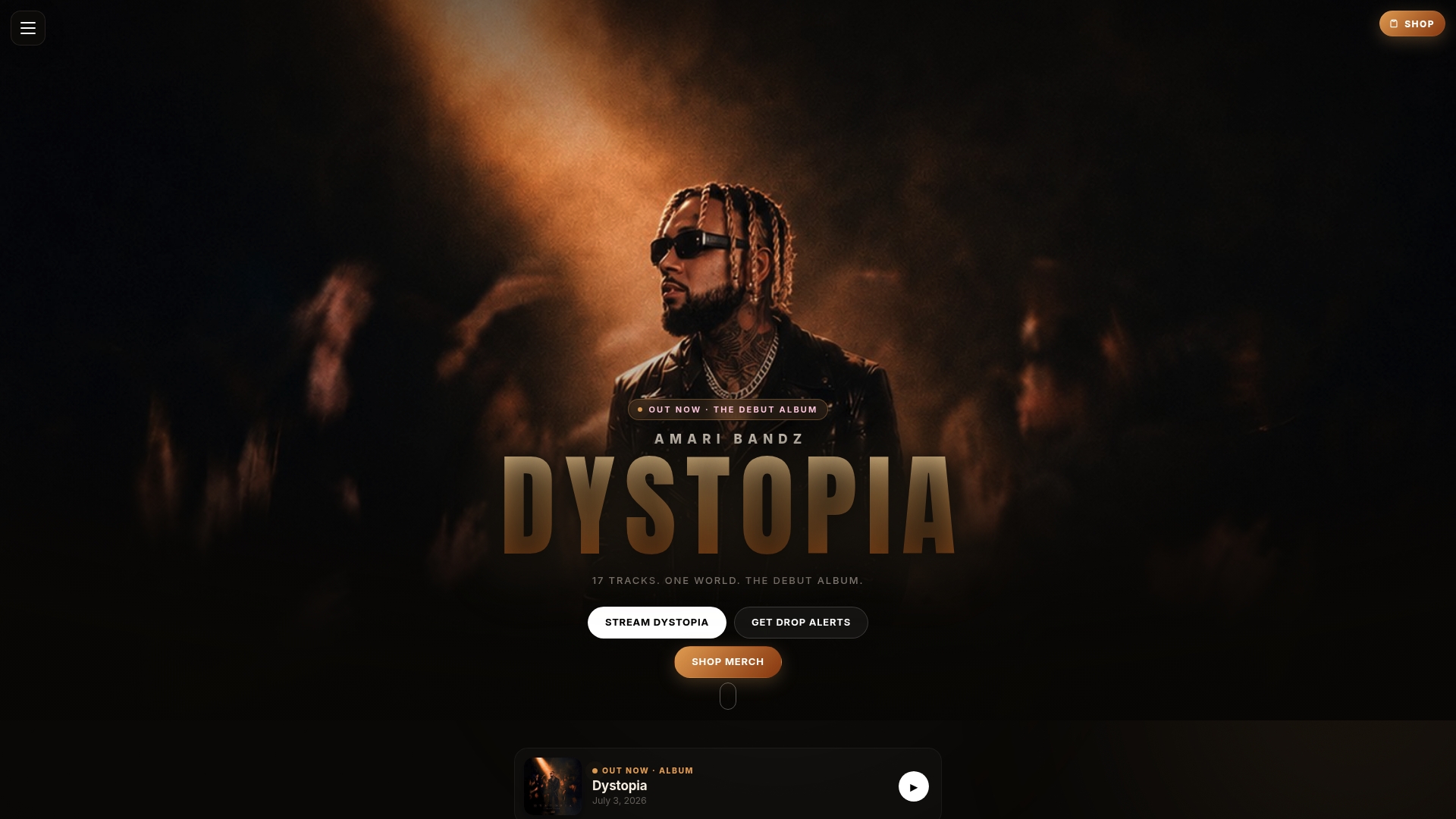
Instead of routing fans through a bio link to a streaming platform, Amaribandz puts the music, the merch, and the fan relationship on one owned page. Tracks like "Japan," "Beautiful High," and "Currency" are accessible directly, alongside artist-branded apparel and accessories and an email and SMS list that delivers exclusive updates before they hit anywhere else. The model is direct-to-consumer: no algorithm deciding who sees your new release, no platform taking a cut of your merch sale.
For fans who want everything in one place, the central links page connects to every streaming platform and social channel. For artists watching how Amari Bandz structures the fan relationship, it's a practical example of what owning your audience actually looks like in practice. The full artist page is the reference point.
Key Takeaways
Music-specific bio link tools outperform generic alternatives on every dimension that matters for artists: smart routing, pre-save support, email capture, and deliverability on social platforms.
| Point | Details |
|---|---|
| Linktree's price hikes changed the math | Linktree raised its Monetize plan price in November 2025, making purpose-built alternatives more cost-effective. |
| Smart routing reduces fan drop-off | Auto-detecting a fan's preferred platform eliminates the extra click that causes listeners to abandon the process before streaming. |
| Email capture is the most valuable feature | Owning your fan email list protects your audience when algorithms change; choose a tool that includes this without a paywall. |
| Custom domains protect your reach | Generic shared domains like linktr.ee get flagged as spam by Instagram and TikTok; music-specific platforms with clean domains avoid this. |
| Amaribandz models direct fan ownership | Amari Bandz connects music, merch, and fan communication on one owned platform, bypassing algorithmic gatekeepers entirely. |